Quick answer
Corns and calluses are thickened skin where your foot is being repeatedly rubbed or pressed. They’re protective, the skin builds up to defend itself. They’re not dangerous, but they can hurt, and they always have a cause. Removing the thickened skin without addressing the cause means it’ll come right back.
Important, get evaluated first. A callus or corn can hide a deeper problem underneath. In people with diabetes or peripheral neuropathy in particular, a callus may be growing on top of an underlying ulceration that you can’t feel, and treating just the surface skin can mask a serious infection. Other times a corn sits over a bony abnormality, an infection, or rarely a skin cancer. Any new, painful, growing, or dark-centered callus or corn, and any callus or corn at all in someone with diabetes, neuropathy, or poor circulation, should be evaluated by a podiatrist or other clinician before any home treatment.
Corn vs. callus: what’s the difference
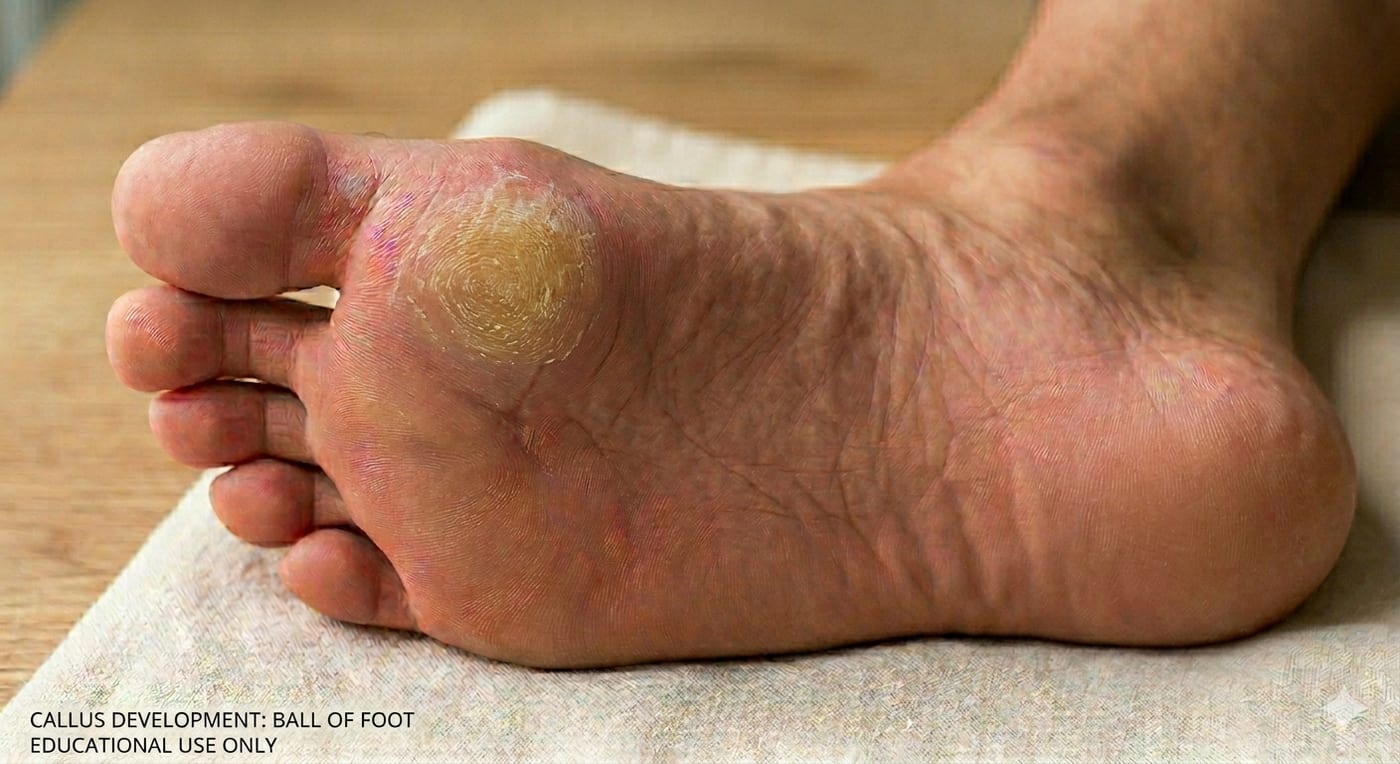
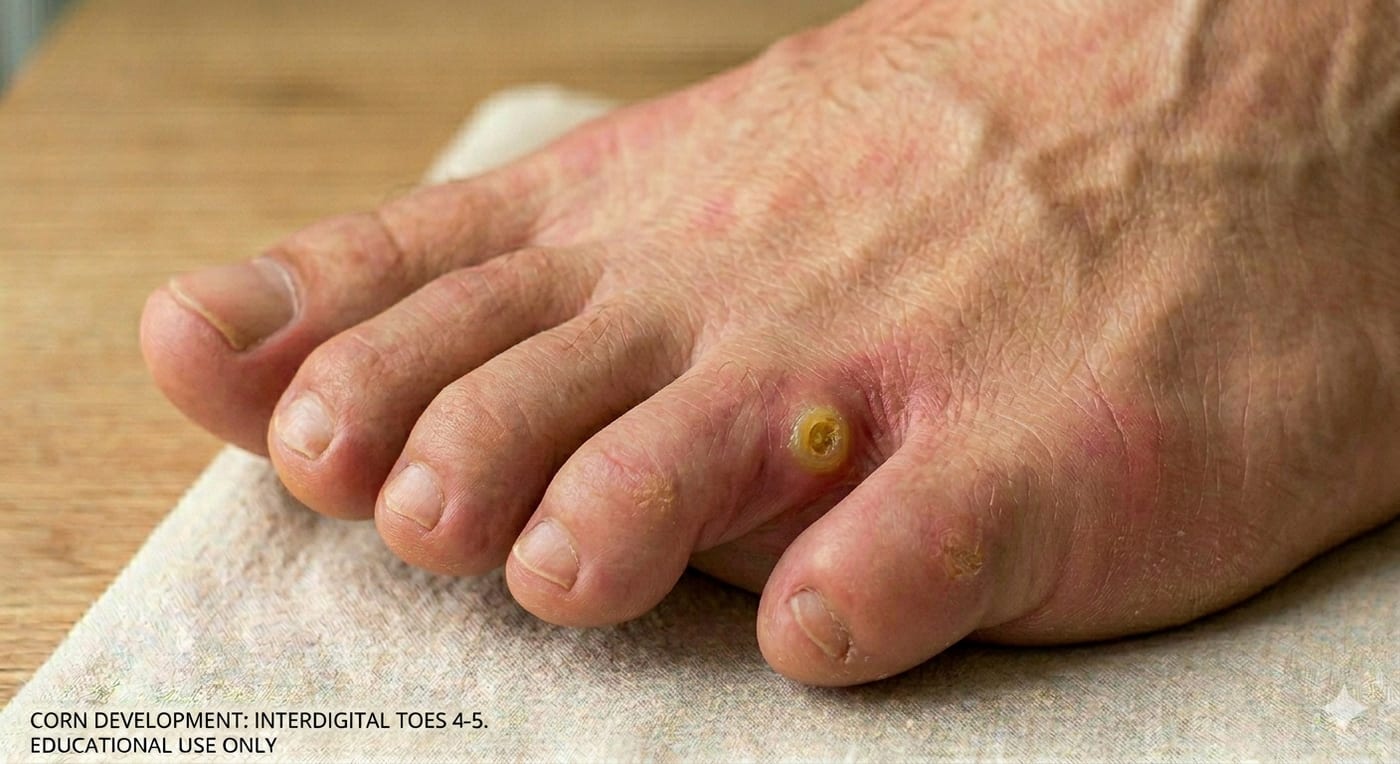
| Callus | Corn | |
|---|---|---|
| Size | Broad, diffuse | Small, focused |
| Where | Weight-bearing areas (heel, ball of foot) | Pressure points on or between toes |
| Center | Uniformly thick | Has a hard core (“nucleus”) |
| Pain | Often painless | Usually tender, especially when pressed |
Two corn types matter clinically:
- Hard corns: on top of toes or sides where shoes rub
- Soft corns: between toes (kept moist by the space, look whitish)
Why they form
The body creates extra layers of skin in response to repeated mechanical stress. The stress comes from somewhere:
- Shoes that don’t fit: too tight (corns on toes), too loose (calluses from sliding), too narrow (5th toe corns)
- Foot deformities: bunions (medial big toe callus), hammertoes (top-of-toe corns), claw toes, dropped metatarsal heads (ball-of-foot calluses)
- Gait patterns: overpronation, supination, walking on the outside of the foot
- Bone prominences: abnormal bony bumps create local pressure
- Activities: running, dancing, repetitive movement
- Going barefoot on hard surfaces
A callus is your foot telling you something about how you’re loading it.
What to do about them
Step 1: Address the cause
This is the part most people skip. Without it, you’re treating a symptom.
- Reassess your shoes: adequate width, depth, soft uppers
- Replace worn shoes: collapsed cushioning concentrates pressure
- Use protective padding: moleskin, gel toe sleeves, metatarsal pads
- Toe spacers for soft corns between toes
- Custom orthotics if foot mechanics are the issue
Step 2: Reduce the thick skin gently
- Soak feet in warm water for 5–10 minutes
- File gently with a pumice stone or foot file (only after soaking, only on healthy skin)
- Moisturize afterward to keep skin pliable
- Don’t try to remove all of it at once: over-aggressive filing can cause wounds
Skip the filing step entirely if you have diabetes, peripheral neuropathy, or any condition that reduces sensation in your feet. You can’t reliably tell healthy callus from injured skin by feel, and what looks like “thick skin” might already be compromised. See a podiatrist for safe in-office debridement.
Step 3: Know when to leave it alone
Some calluses are protective. A modest callus on the ball of the foot of an active person isn’t a problem and shouldn’t be aggressively reduced.
What NOT to do
- Over-the-counter “corn removers” with salicylic acid, controversial. They work on healthy callused skin but can damage surrounding healthy tissue and cause wounds. Avoid entirely if you have diabetes, neuropathy, or poor circulation.
- Don’t cut into corns/calluses with scissors or razors at home, high infection risk
- Don’t ignore a callus that’s changing: getting redder, darker, or developing a black spot underneath. In someone with diabetes this is a pre-ulcer warning.
When to see a clinician
- Painful corns or calluses limiting activity
- Recurring ones despite shoe changes
- Any callus that’s changed color, gotten redder, or developed a darker spot
- A small, deep, sharply painful spot that hurts disproportionately for its size, this can be porokeratosis plantaris discreta (PPD), which looks like a callus but has a deep keratin core and needs different treatment
- You have diabetes, peripheral arterial disease, or any condition affecting sensation or circulation
- Visible deformity (bunion, hammertoe) is causing the corn
- You can’t safely care for them yourself (poor eyesight, can’t reach feet)
A podiatrist can debride (professionally pare down) thick callus, identify the underlying cause, and recommend padding or orthotics.
When the cause is structural: surgical correction
Sometimes a corn or callus keeps coming back because there’s a bony or positional problem driving it. Conservative care (shoes, padding, orthotics, periodic debridement) keeps things manageable, but only surgery addresses the root cause. The list below is a sample of common scenarios, not an exhaustive list, and not surgical recommendations. Every foot is different, and the right procedure (if any) depends on a hands-on exam, weight-bearing X-rays, and a discussion of goals and risks with your podiatrist.
- Hammertoe or claw toe: a buckled toe creates pressure on top of the PIP joint, producing a hard corn there. PIP arthroplasty or fusion is one option that may be considered
- Adductovarus deformity of the 5th toe: the small toe rotates inward and digs into the 4th, producing a soft corn between them. Surgical derotation (capsulotomy, arthroplasty, sometimes tendon release) is one approach that may apply
- Tailor’s bunion (bunionette): a prominent 5th metatarsal head creates a corn or callus on the lateral foot. A 5th metatarsal osteotomy is one of several techniques surgeons use
- Bunion: medial pressure from a deviated 1st metatarsal creates a callus or corn on the medial big toe. Various bunion correction procedures exist; the choice depends on the severity and angle of deformity
- Dropped metatarsal head: one metatarsal sits lower than the others and concentrates pressure into a focal callus on the ball of the foot. A metatarsal osteotomy may redistribute the load
- Dorsal exostosis: a bony bump on the top of the foot or toe creates pressure against the shoe. Exostectomy (removal of the bony prominence) is a possibility
- Plantar exostosis or prominent metatarsal head: bone spurs on the plantar surface can cause focal calluses; surgical reduction is sometimes considered
No one-size-fits-all surgery. The procedures above are illustrative examples of how structural problems are sometimes addressed, not a treatment plan. The right approach for any individual depends on the specific anatomy, severity, foot mechanics, activity level, medical history, surgical history, and personal goals. Some structural problems are best left alone; some need a different procedure than the one named above; some require a combination of procedures. Always consult a podiatrist or foot-and-ankle surgeon for a personalized evaluation before considering any surgical intervention. Surgery, even a “small” foot procedure, carries risks including infection, recurrence, nerve injury, prolonged recovery, and outcomes that don’t fully match expectations.
Surgery isn’t first-line for most patients. Orthotics, shoe changes, and selective debridement keep many people comfortable indefinitely. When surgery is the right next step, your podiatrist will walk through the specifics of your case, the alternatives, expected recovery, and what success and failure look like for the proposed procedure.
Prevention
- Get shoes fitted in the afternoon when feet are slightly larger
- Wide toe boxes, soft uppers, low heels for daily wear
- Replace shoes as they wear
- Inspect feet weekly: catch problem areas early
- Address foot deformities (bunions, hammertoes) before they create chronic pressure
- Moisturize dry skin to maintain elasticity
Last updated: April 26, 2026

About the author
Written and reviewed by a Doctor of Podiatric Medicine (DPM) practicing in Arizona for 6+ years. Board-certified by the American Board of Podiatric Medicine (ABPM); graduate of Midwestern University Arizona College of Podiatric Medicine.
Last clinically reviewed: April 26, 2026