
Quick answer
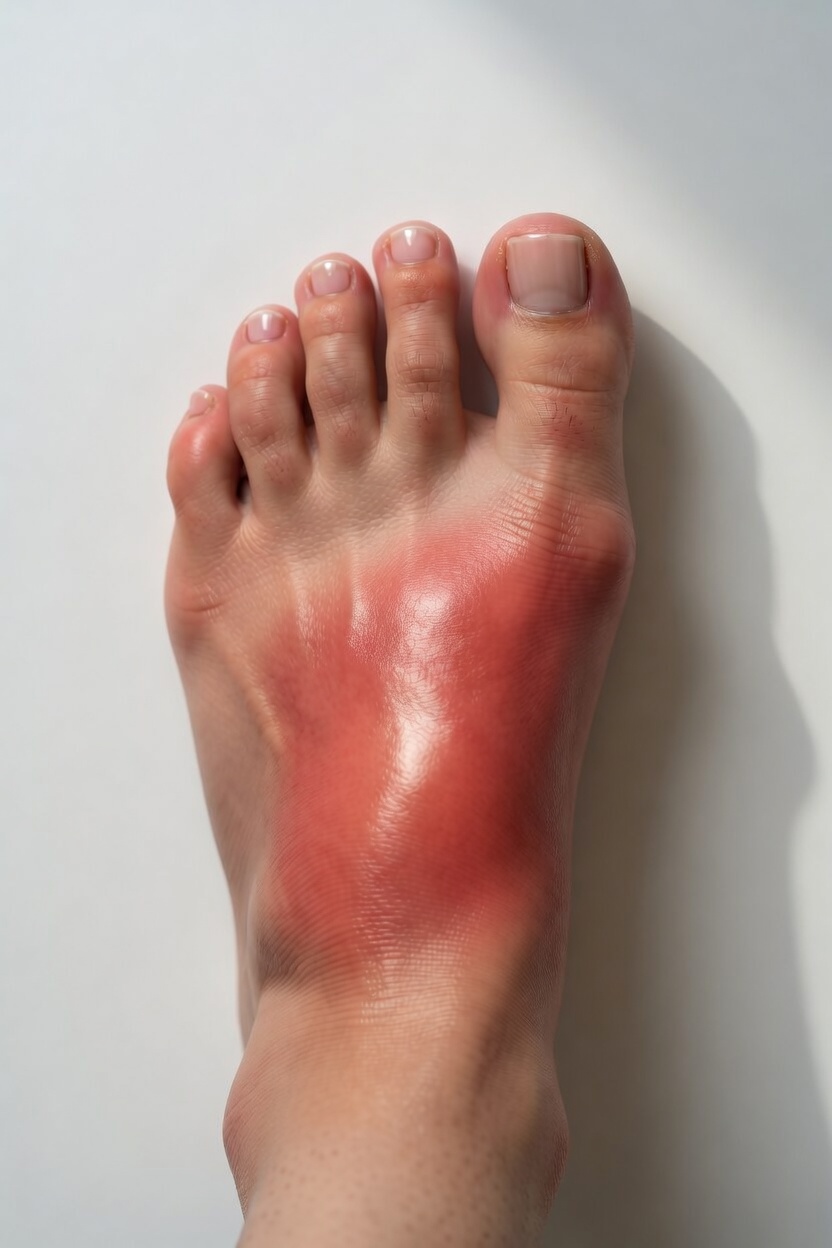
Cellulitis is a bacterial infection of the skin and soft tissue layers just beneath it. On the foot, it typically presents as a spreading area of redness, warmth, swelling, and pain, often starting from a small break in the skin that went unnoticed. Most cases respond to oral antibiotics started promptly, but cellulitis can escalate quickly, especially in people with diabetes or poor circulation, into deeper soft-tissue infection, osteomyelitis, sepsis, or necrotizing fasciitis (a surgical emergency that can be fatal within hours).
911 / emergency department now if any of the following: severe pain that feels out of proportion to what you see on the skin, dusky or blackening patches within the redness, blisters that fill with bloody or murky fluid, rapidly advancing redness despite oral antibiotics, fever and confusion or fast heart rate, or any of these signs in someone with diabetes. These features can mean necrotizing fasciitis: a flesh-eating soft-tissue infection that requires immediate surgery to survive.
How to recognize it
The classic signs:
- Spreading redness: not a fixed red spot, but an area that visibly enlarges over hours to a day
- Warmth: the affected skin feels noticeably hot
- Swelling
- Tenderness when touched
- Firm, tight skin as the area fills with fluid
- Sometimes fever, chills, or feeling unwell: signs the infection is more than skin-deep
Red flags for more serious infection:
- Red streaks running up the foot or leg (lymphangitis, tracking toward lymph nodes)
- Blistering or skin breakdown over the infected area
- Rapidly spreading boundaries despite antibiotics
- Severe pain out of proportion to appearance, can signal necrotizing fasciitis
- Pus or fluctuance: suggests a pocket of infection (abscess) that may need drainage
- Fever above 38.5°C / 101.3°F or low blood pressure
- Altered mental status in severe systemic cases
- Any foot infection in a person with diabetes: escalates faster and reaches deeper
Why this happens
Cellulitis follows a break in the skin that lets bacteria, usually Staphylococcus aureus or Streptococcus pyogenes: enter the deeper layers of tissue.
Common entry points:
- Tinea pedis (athlete’s foot): probably the most common gateway on the foot; the cracking skin between toes is a literal door for bacteria
- Cuts, abrasions, or lacerations
- Puncture wounds or bites
- Ingrown toenails
- Cracks from dry heels
- Blisters from shoes
- Surgical wounds
- IV drug injection sites
- Minor trauma (often too small to remember)
Who’s at higher risk
- Diabetes: impaired immune response, neuropathy (pain is missed), and poor circulation all stack the odds
- Peripheral arterial disease: poor blood flow prevents immune cells from reaching the area
- Lymphedema: lymphatic fluid backup impairs local immunity and creates a warm, moist environment
- Obesity: impairs wound healing and skin integrity
- Immunosuppression: transplant medications, chemotherapy, HIV, steroids
- Chronic venous insufficiency: stasis dermatitis creates fragile skin
- Prior cellulitis: recurrence is common (roughly 8 to 20% per year, and as high as 49% over time)
Diagnosis
Cellulitis is usually a clinical diagnosis: based on the appearance and exam, without lab tests for most cases.
However, a clinician may order:
- Blood count and inflammatory markers (CBC, CRP, ESR), help gauge severity and systemic involvement
- Blood cultures: for patients with fever, suspected bacteremia
- Wound culture: if there’s an open entry point or abscess
- X-rays or MRI: when osteomyelitis or deep infection is suspected (especially in diabetic patients)
- Ultrasound: to detect an underlying abscess that needs drainage
What cellulitis is NOT
- It doesn’t have pus unless there’s a co-existing abscess
- It doesn’t have a sharp, raised, well-demarcated border (that pattern, especially with systemic illness, suggests erysipelas, a superficial variant)
- It’s not a bite or rash from an insect unless the history fits
Treatment
Oral antibiotics (outpatient, mild-to-moderate cases)
Most cellulitis is treated with a course of oral antibiotics:
- Oral antibiotics targeting staph and strep, your clinician selects the agent based on local resistance patterns, whether MRSA is suspected, and your medical history.
- Duration: typically 5–7 days, extended if not responding
- Most cases improve within 48–72 hours: improvement of redness, warmth, swelling
- Mark the border of redness with a skin marker to track whether it’s spreading or receding
Intravenous antibiotics (hospitalization)
Needed when:
- Rapidly spreading, despite oral antibiotics
- High fever or signs of systemic infection
- Immunocompromised patient
- Unable to take oral medication
- Diabetes with foot cellulitis, often hospitalized
- Near a joint or bone (risk of joint infection or osteomyelitis)
- Failure of outpatient treatment within 48 hours
IV antibiotic choice is determined by the treating clinician based on suspected organism and local resistance patterns.
Supportive care
- Elevation of the foot, reduces swelling, promotes drainage
- Rest: limit weight bearing
- Treat the entry point: address the tinea pedis, ingrown nail, or wound that started the infection
Abscess drainage
If an abscess has formed (fluctuant, pus-filled pocket):
- Incision and drainage is the definitive treatment for the abscess
- Antibiotics alone typically don’t fully resolve a walled-off abscess
Special situations
Cellulitis in diabetes
This deserves its own category. A diabetic patient with foot cellulitis:
- Often doesn’t feel it: neuropathy masks pain until the infection is advanced
- Is at higher risk for osteomyelitis (bone infection)
- May have polymicrobial infection (multiple organisms including gram-negative bacteria and anaerobes)
- Needs imaging to evaluate for deep infection and osteomyelitis
- Often needs hospitalization and IV antibiotics
- Needs wound care if there’s an ulcer
- May need vascular surgery consultation for inadequate blood flow
- Has a higher risk of amputation if not treated promptly
Recurrent cellulitis
Recurrence is common, roughly 8 to 20% per year. Prevention strategies:
- Treat tinea pedis aggressively: the #1 modifiable risk factor for leg/foot cellulitis
- Moisturize cracked, dry skin on the feet
- Wear appropriate footwear: especially in people with diabetes
- Compression stocking for patients with lymphedema or venous insufficiency
- Prophylactic antibiotics: daily low-dose suppression may be considered for patients with 3+ episodes per year; the specific regimen is determined by your clinician.
Bottom line
Cellulitis is a spreading bacterial skin infection that needs prompt antibiotic treatment. Most cases respond to oral antibiotics started early. The warning signs that require urgent care: rapid spread, fever, red streaks, blistering, or any foot infection in a person with diabetes. Treating the underlying entry point, especially athlete’s foot and dry cracked skin, is the key to preventing recurrence.
Sources
- Brown BD, Syed HA, Hood Watson KL. Cellulitis. StatPearls (updated 2025) ↗
- Stevens DL, Bisno AL, Chambers HF, et al. Practice Guidelines for the Diagnosis and Management of Skin and Soft Tissue Infections: 2014 Update by the Infectious Diseases Society of America. Clin Infect Dis ↗
- Wallace HA, Perera TB. Necrotizing Fasciitis. StatPearls ↗
Last updated: July 16, 2026

About the author
Written and reviewed by a Doctor of Podiatric Medicine (DPM) practicing in Arizona for 6+ years. Board-certified by the American Board of Podiatric Medicine (ABPM); graduate of Midwestern University Arizona College of Podiatric Medicine.
Last clinically reviewed: July 16, 2026