Quick answer
A tailor’s bunion is the lateral cousin of a regular bunion, a bony bump at the base of the pinky toe, on the outside of the foot. The name comes from tailors who historically sat cross-legged with the outside of their feet on the floor, irritating the area. Mostly a footwear and pressure problem; surgery is reserved for cases that limit daily life.
How to recognize one
- A bony bump on the outside of the foot at the base of the pinky toe
- Often a callus over the bump where it rubs the shoe
- Pain that’s worse with narrow shoes
- The pinky toe may angle toward the fourth toe over time
- Sometimes redness and swelling around the bump
Why it forms
The fifth metatarsal head (the bone behind the pinky toe) drifts outward, the pinky toe drifts inward, and a prominence develops where the bone now sticks out. The drivers:
- Inherited foot shape: often the strongest factor
- Years in narrow shoes that compress the forefoot
- High heels: push the front of the foot into a narrow toe box
- Foot mechanics: wide forefoot, splayed metatarsals
- Aging: collagen and ligament changes allow more drift
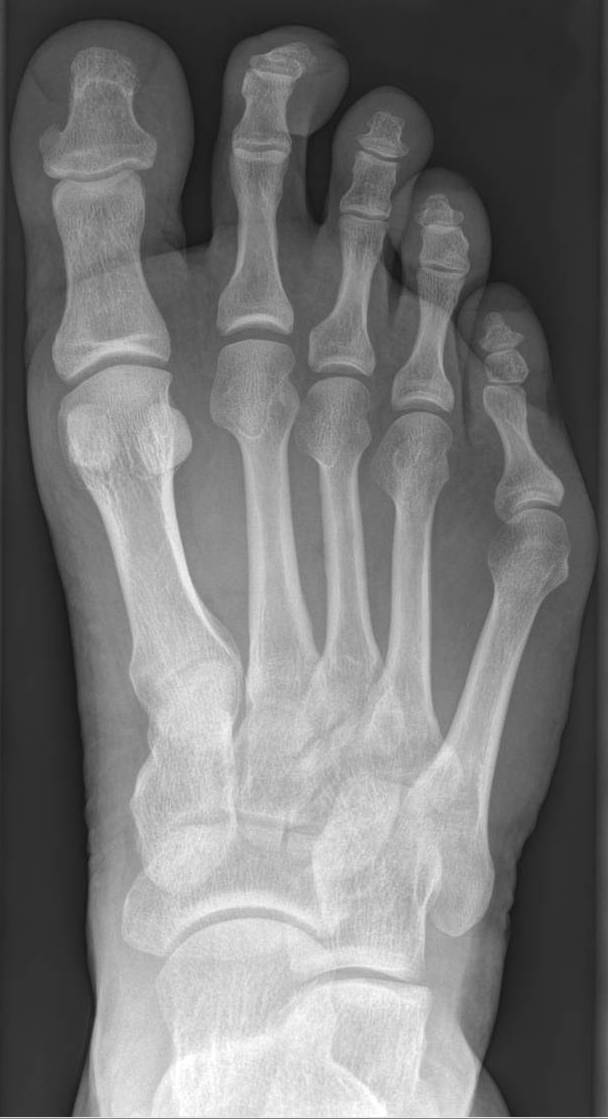
There are three anatomical types: an enlarged fifth metatarsal head (type 1), outward bowing of the metatarsal shaft (type 2), or a widened angle between the fourth and fifth metatarsals (type 3, the splayed forefoot seen on the X-ray above). The type matters because it guides which procedure helps if surgery is ever considered.
What to do about it
Conservative care (works for most people)
- Wider shoes: soft uppers, roomy toe box. The single most impactful change.
- Avoid narrow / pointed / high heel shoes for daily wear
- Bunionette pads: donut-shaped padding to offload the bump
- Silicone sleeves over the toe to reduce friction
- Ice and NSAIDs for flare-ups
- Custom orthotics in some cases to redistribute pressure
- Address the callus: gentle filing after soaking, but no aggressive removal
Surgery: when conservative care isn’t enough
Several procedures exist depending on which bony deformity is dominant:
- Bone shave (exostectomy): removes just the bump
- Osteotomy: cuts and repositions the fifth metatarsal
- Distal vs. proximal osteotomy: depending on where the deformity is
Recovery is typically 6–8 weeks, with a stiff post-op shoe and limited weight-bearing initially. Outcomes are generally good for the right candidate.
When to see a clinician
- Pain that limits walking or shoe choice
- Recurring callus or skin breakdown over the bump
- Visible deformity that’s getting worse
- Conservative measures haven’t helped after 2–3 months
- You have diabetes, even minor friction warrants closer attention
Bottom line
A small bunionette without symptoms doesn’t need treatment. If it’s painful or limiting your shoes, start with footwear changes: most people improve significantly. Surgery is a real option for stubborn cases but isn’t first-line.
Frequently asked questions
Can I get rid of a tailor's bunion without surgery?
You can usually get rid of the pain without surgery, but not the bump itself. The prominence is bone, so pads, wider shoes, and better mechanics won't shrink it. What they do very well is stop the rubbing and pressure that make it hurt, and for most people that's enough. Surgery is the only way to remove the bump, and it's reserved for cases that stay painful despite good footwear.
What's the difference between a tailor's bunion and a regular bunion?
Location. A regular bunion forms at the base of the big toe on the inside of the foot; a tailor's bunion forms at the base of the pinky toe on the outside. The mechanics mirror each other: the metatarsal drifts outward, the toe angles the other way, and a bony prominence takes the shoe pressure. People with a wide, splayed forefoot often have both.
Do tailor's bunion correctors and splints actually work?
Toe spacers and splints don't realign the bone, so they can't correct the deformity. What helps is anything that reduces pressure over the bump: a roomy toe box, soft uppers, and a silicone sleeve or donut pad. Those relieve symptoms for most people even though the bump itself stays.
When does a tailor's bunion need surgery?
When it still hurts or breaks down the skin despite 2 to 3 months of genuinely wider shoes and padding, or when it limits daily activity. The procedure depends on the anatomy: shaving the prominence for an enlarged metatarsal head, or an osteotomy to reposition the fifth metatarsal when the bone bows or splays. Recovery typically runs 6 to 8 weeks.
Why is it called a tailor's bunion?
Tailors historically worked sitting cross-legged, with the outer edges of their feet pressed against the floor for hours. That constant pressure over the fifth metatarsal head irritated the area and produced the classic bump, so the name stuck. Today, narrow shoes play the role the workshop floor used to.
Sources
Last updated: July 18, 2026

About the author
Written and reviewed by a Doctor of Podiatric Medicine (DPM) practicing in Arizona for 6+ years. Board-certified by the American Board of Podiatric Medicine (ABPM); graduate of Midwestern University Arizona College of Podiatric Medicine.
Last clinically reviewed: July 18, 2026