
Quick answer
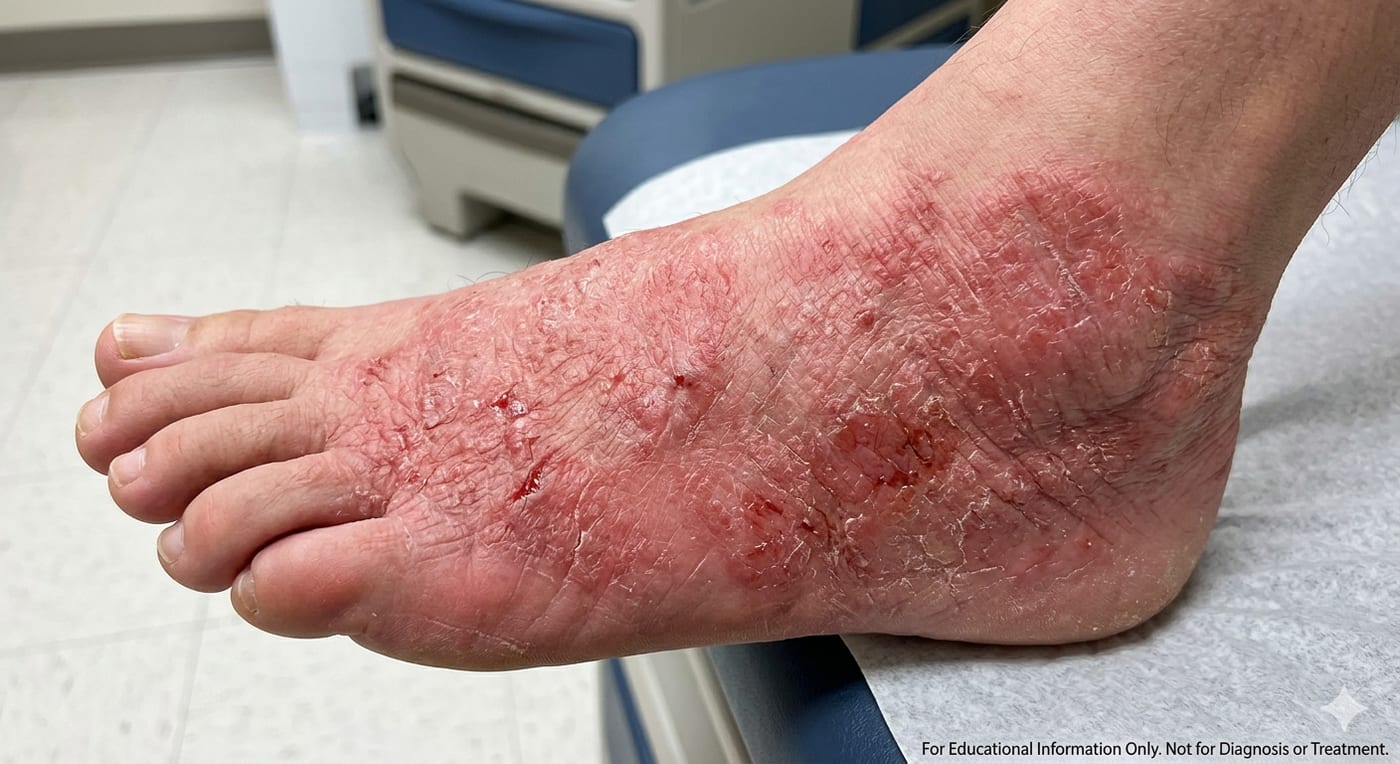
Contact dermatitis is a skin reaction to something the foot touches. It’s often confused with athlete’s foot or eczema, but a key clue is the distribution: the rash often matches the exact shape of whatever caused it (a shoe strap, sock band, sandal contact, applied lotion). There are two main types:
- Irritant contact dermatitis: direct chemical or physical damage to the skin (most common)
- Allergic contact dermatitis: a delayed immune reaction to a substance the body has become sensitized to
Important, get evaluated first. A persistent foot rash should be properly identified. Athlete’s foot (fungal), eczema, psoriasis, scabies, and contact dermatitis can look similar but need different treatments. Treating the wrong thing wastes time. Especially get evaluated if you have diabetes, peripheral neuropathy, or poor circulation: any non-healing skin issue on the foot in this group needs clinical attention.
Common triggers
Shoe-related
The single most common cause of foot contact dermatitis. Common culprits:
- Rubber accelerators (mercaptobenzothiazole, thiurams, carbamates), used in rubber shoe soles, elastic, and athletic shoes
- Leather tanning agents: especially chromium (chromate) salts in tanned leather
- Adhesives and glues (PTBP-formaldehyde resin, colophony), used to assemble shoes
- Dyes in leather and fabric
- Formaldehyde and related preservatives
- Nickel: buckles, eyelets, decorative metal
The classic distribution: a rash matching the upper (dorsal) part of the foot following the shoe outline, or between the toes from rubber-containing inserts, or along the side or back of the heel from a specific contact point.
Sock-related
- Dyes (especially dark colors)
- Formaldehyde finishes in some synthetic fabrics
- Latex in elastic bands
Topical product–related
- Antibiotic ointments (neomycin and bacitracin are well-known sensitizers)
- Topical antifungals (paradoxically, can cause contact dermatitis in some people)
- Antiperspirants and foot powders
- Fragrances and preservatives in lotions
- Adhesives in bandages and tape
Environmental
- Plants (poison ivy, poison oak, less common on feet but possible if barefoot in vegetation)
- Cleaning products if applied directly or splashed
Irritants (less specific, more direct damage)
- Prolonged moisture: sweat trapped in shoes
- Strong soaps
- Solvents and chemicals
How to recognize it
- Rash matches the contact area: sharp borders following a shoe strap, sock band, sandal pattern
- Itchy (allergic type) or burning/stinging (irritant type)
- Redness, swelling, sometimes small blisters: usually on the dorsum (top) or sides of the foot, less often the soles
- Symmetric if both feet are exposed (e.g., same shoes); asymmetric if only one foot is in contact (rare)
- Develops 24–72 hours after exposure for allergic type, so the link isn’t always obvious
- Develops within minutes to hours for irritant type, direct damage
- Often recurs in the same pattern when the trigger is reintroduced (a clue worth tracking)
Allergic vs. irritant: why it matters
| Allergic | Irritant | |
|---|---|---|
| Mechanism | Immune (Type IV hypersensitivity) | Direct chemical damage |
| Onset | 24–72 hours after exposure | Minutes to hours |
| Sensation | Itchy | Stinging, burning |
| Distribution | Anywhere the allergen touched | Where the irritant touched, sometimes worse in moist areas |
| Confirmation | Patch testing | Clinical pattern, exclusion |
| Resolution | Once allergen is identified and avoided | When irritant is removed; skin barrier needs to recover |
| Recurrence | Will recur on re-exposure (often worse) | Depends on intensity and frequency of exposure |
Diagnosis
- History and exam: the pattern of the rash is often diagnostic
- KOH prep: to rule out fungal infection
- Patch testing: for suspected allergic contact dermatitis. A panel of common allergens is applied to the back; reactions read at 48 and 96 hours. The gold standard for identifying the specific allergen
- Skin biopsy: occasionally, when the diagnosis is unclear
Patch testing is particularly valuable because the offending substance is often something the patient hasn’t suspected, and identifying it lets you avoid it.
Treatment
Step 1: Identify and remove the trigger
The most important step. Treatment without trigger removal usually fails.
- Switch shoes: try a known low-allergen brand or all-natural materials
- Change socks: natural cotton without dyes
- Stop suspected creams or ointments
- Avoid known triggers if patch testing has identified them
Step 2: Treat the inflammation
- Cool compresses for acute weeping or vesicular lesions
- Topical corticosteroids: strength matched to severity and skin location. Specific medication and dosing determined by your clinician
- Oral antihistamines for itch, especially at night
- Oral corticosteroids: for severe, widespread, or refractory cases. Short course only
- Topical calcineurin inhibitors: tacrolimus or pimecrolimus as steroid-sparing alternatives, especially in thinner skin
Step 3: Restore the skin barrier
- Moisturize daily with bland, fragrance-free creams or ointments
- Avoid hot water: strips natural oils
- Mild cleansers
- Time: even after the trigger is removed, the skin barrier takes 2–4 weeks to fully recover
When to see a clinician
- Diagnosis is unclear: particularly if antifungals haven’t helped
- Severe or widespread reaction
- Not improving after 1–2 weeks of trigger removal and over-the-counter treatment
- Frequent recurrences without a clear pattern (need patch testing)
- Signs of secondary infection (increased redness, warmth, pus, fever)
- You have diabetes, peripheral neuropathy, or poor circulation
Bottom line
Contact dermatitis on the feet is one of the most missed diagnoses in general practice, often called “athlete’s foot” for months before someone notices the rash matches a shoe strap exactly. The clinical clue is the distribution: a rash that follows the shape of the contact is contact dermatitis until proven otherwise. Patch testing identifies the specific culprit in allergic cases, and once you know what to avoid, the rash typically resolves and stays gone.
Last updated: April 28, 2026

About the author
Written and reviewed by a Doctor of Podiatric Medicine (DPM) practicing in Arizona for 6+ years. Board-certified by the American Board of Podiatric Medicine (ABPM); graduate of Midwestern University Arizona College of Podiatric Medicine.
Last clinically reviewed: April 28, 2026