
Quick answer
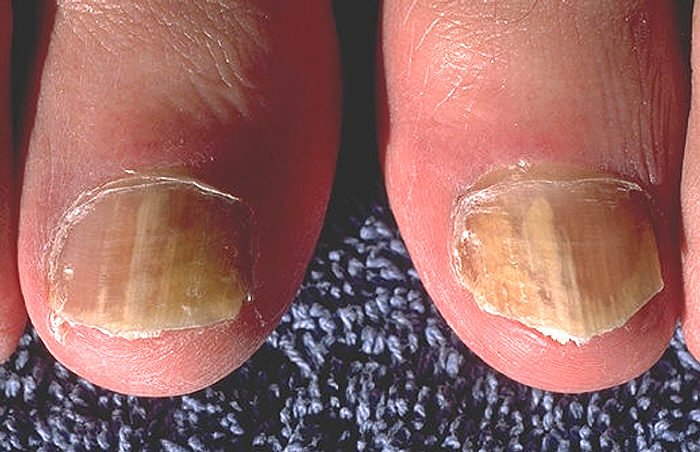
Toenail fungus is a stubborn but treatable infection inside or under the nail. It’s caused by the same family of fungi that cause athlete’s foot, often spreading from the skin to the nails. Treatment works, but it’s slow. Plan on 9–12 months before you see a fully healthy nail.
How to recognize it
- Thickened nails
- Yellow, white, brown, or green discoloration
- Brittle or crumbling edges
- Nail separating from the nail bed (a pattern called onycholysis, fungus is one cause, but trauma, psoriasis, and certain medications also produce it)
- Distorted shape
- Foul smell in some cases
- No pain typically: but advanced cases can be uncomfortable in shoes
The big toe is most often affected. Multiple nails can be involved, especially if untreated.
Not every thick, discolored toenail is fungus
Fungus is the most common reason toenails thicken and yellow, but it is not the only one, and this matters because months of antifungal treatment on the wrong diagnosis is a real waste. In clinic, the differential includes:
- Onychauxis (age- or pressure-related thickening): the nail thickens uniformly without the crumbling edge, subungual debris, or yellow-brown discoloration that fungus produces. Very common in older adults, and in single nails under chronic pressure from a bunion or hammer toe.
- Onychogryphosis (“ram’s horn nail”): severe overgrowth with a curved, thickened, yellow-brown appearance, often in an older adult whose nails have not been trimmed in a long time. It mimics fungus closely but does not respond to antifungals; the treatment is debridement.
- Old nail trauma or subungual hematoma: a single nail thickens and discolors after an injury, sometimes months or years later, without any fungus involved.
- Nail psoriasis: pitting, oil-drop discoloration under the nail, and thickening that co-occurs with psoriasis elsewhere on the body. Antifungals do nothing for it.
- Rarely, subungual melanoma: a dark streak or pigmented change in one nail that widens or spreads to the surrounding skin. This is the diagnosis you must not miss.
This is why confirming the diagnosis before committing to a long course of antifungal treatment is worth the effort. A nail clipping for KOH prep or PCR takes minutes; a wasted year of treatment does not.
What’s actually causing it
The most common culprit is a dermatophyte fungus, most often Trichophyton rubrum, the same organism that causes athlete’s foot. Less commonly, yeasts (Candida) or molds are responsible. The fungus thrives in:
- Warm, moist environments: sweaty shoes, public showers, gyms
- Damaged nails: from injury or repetitive trauma (athletes, runners)
- Compromised immunity: diabetes, HIV, chemotherapy, older age
It’s contagious but not very, most adults won’t catch it from casual exposure. Repeated barefoot exposure on contaminated surfaces is the typical scenario.
Why treatment is so slow
A healthy big toenail takes 12–18 months to grow out completely. The medications kill the fungus, but the infected nail has to grow out before you see a normal-looking nail. That’s why you’ll feel like nothing is happening for months, but if the nail’s growing out clear, the treatment is working.
Treatment options
Confirm the diagnosis first (worth the effort)
Lots of nail conditions can mimic fungus: psoriasis, repeated nail trauma and subungual hematoma, lichen planus, even melanoma. Before committing to long treatment:
- Nail clipping for KOH prep / culture / PCR can confirm fungus
- Skip empiric treatment if you’re not sure, treating the wrong thing wastes time and money
Topical treatments
- Ciclopirox 8% nail lacquer (Penlac): daily for 48 weeks. The “success rate” depends heavily on which endpoint is measured. Mycological cure (negative fungal culture) was reported at roughly 30–35% in the FDA pivotal trials, but the clinically meaningful endpoint, complete cure (a healthy-appearing nail plus a negative culture), was much lower, around 5–9%. Real-world clinical experience tracks with the lower number. Ciclopirox is a reasonable choice for mild distal disease, when oral therapy is contraindicated, or as an adjunct, but it should not be expected to clear moderate or severe nail fungus on its own.
- Efinaconazole 10% solution (Jublia): daily for 48 weeks. Complete cure rates of roughly 15–18% in the pivotal trials, better than ciclopirox, still well below oral therapy.
- Tavaborole 5% solution (Kerydin): daily for 48 weeks. Complete cure rates of roughly 6.5–9% in the pivotal trials, closer to ciclopirox than to efinaconazole.
Topicals work best for mild infections involving the nail edge and people who can’t take oral medication. Realistic expectations matter: even the best topical options clear the disease in fewer than 1 in 5 patients. Oral therapy is substantially more effective when it can be used safely.
Oral treatments (most effective)
- Terbinafine (Lamisil), typically taken daily for about 12 weeks; specific dosing is determined by your clinician. The first-line treatment in most cases. Cure rates around 60–70%.
- Itraconazole: alternative; pulse dosing
- Fluconazole: used for yeast infections
Oral antifungals are more effective but require:
- A liver function test before and sometimes during treatment
- Awareness of drug interactions
- Patience, even after a 12-week course, the nail takes another 6–9 months to grow out healthy
Procedural options
- Laser therapy: heats the fungus; not always covered by insurance, evidence mixed
- Surgical or chemical nail removal: for severe cases or when other treatments fail; allows topical treatment to reach the nail bed directly
Home remedies
- Vicks VapoRub, tea tree oil, vinegar soaks: anecdotal evidence; some small studies suggest minor benefit. Not proven, but generally low-risk to try alongside or before formal treatment.
When to see a clinician
- The diagnosis isn’t clear (so you don’t waste months treating the wrong thing)
- Over-the-counter treatment isn’t working after 6 months
- Multiple nails are infected
- You have diabetes or compromised circulation, don’t self-treat
- The nail is painful or you can’t fit shoes
Prevention (and avoiding recurrence)
Toenail fungus loves to come back. Cut the cycle:
- Treat athlete’s foot at the same time, re-infection from skin is the main reason fungus returns
- Keep feet dry: change wet socks promptly
- Antifungal powder in shoes after treatment
- Rotate shoes so each pair has 24+ hours to dry between wears
- Don’t share nail clippers, towels, shoes
- Shower sandals in public locker rooms and pool decks
- Clip nails straight across, not too short
- Treat early: small infections clear faster than advanced ones
Frequently asked questions
Can toenail fungus be cured?
Yes, but it takes patience. Oral antifungals (terbinafine, itraconazole) cure 60–70% of cases over 3–6 months. Topical treatments work far less well (complete cure roughly 6–18% depending on the agent) but are safer. Even with successful treatment, it takes 9–12 months for the new healthy nail to fully grow out.
What is the fastest way to get rid of toenail fungus?
There's no fast cure, the nail itself grows slowly. Oral terbinafine for 12 weeks is the most effective single treatment, but visible improvement takes months because new healthy nail has to grow out from the base. Topical treatments are slower and less effective but avoid systemic side effects.
Does toenail fungus go away on its own?
No, without treatment, toenail fungus typically persists or spreads. Untreated, it can also serve as a reservoir reinfecting the surrounding skin with athlete's foot. Some people choose to leave mild cases alone if the nail isn't bothersome.
Is toenail fungus contagious?
Yes, but transmission is slow. The fungus spreads through contact with contaminated surfaces (showers, pool decks) or shared shoes/socks. Most adults pick it up after years of low-level exposure, especially after a small nail injury that lets fungus enter. It's not as easily transmitted as athlete's foot.
Why do I keep getting toenail fungus?
Recurrence is common because: the original infection wasn't fully eradicated, the shoes still harbor fungus, athlete's foot continues to reinfect the nail, or the nail has structural changes from prior infection. Successful long-term treatment usually means treating shoes, addressing skin fungus, and full-course oral antifungals.
Can you wear nail polish with toenail fungus?
It's not ideal during active treatment, polish traps moisture and blocks topical antifungals from penetrating. If you must wear polish for an event, use it briefly and remove it after. Anti-fungal medicated polishes (ciclopirox) exist but are less effective than oral medications.
How long does it take to get rid of toenail fungus?
Longer than most people expect, because the answer has two parts. Killing the fungus with oral terbinafine takes about 12 weeks. Growing out a healthy-looking nail takes another 6 to 12 months on top of that, because the infected portion of the nail has to march out to the tip of your toe. Total time from starting treatment to a normal-looking big toenail is commonly 9 to 15 months. The medication is working long before the nail looks better, which is why patients often quit too early.
How do you know when toenail fungus is going away?
Two signs, in order. First, the new nail growing in from the base (the half-moon area) looks clear, smooth, and normal color; this is the earliest visible marker, usually appearing 2 to 3 months into successful treatment. Second, the line between healthy new nail and thickened old nail moves toward the tip as the healthy nail grows out. The old, thickened part does not turn healthy in place; it grows off. If a month or two after starting treatment the new growth still looks yellow and thickened, the diagnosis or the treatment plan needs to be revisited.
Are all thick, discolored toenails fungus?
No, and this is a common assumption worth pushing back on. Fungus is the most common cause of thick, discolored toenails, but pressure-related thickening (onychauxis), old trauma to the nail, ram's-horn overgrowth (onychogryphosis), nail psoriasis, and rarely subungual melanoma can all look similar. That is why a KOH prep, nail culture, or PCR test is worth doing before starting months of antifungal medication. Treating the wrong problem wastes time and money.
What are the side effects of terbinafine (Lamisil)?
Most people tolerate the standard 12-week course well, but a few side effects are worth knowing about: temporary loss of taste (usually returns after stopping the medication), stomach upset, headache, and rarely a rash. The most-watched risk is liver toxicity, which is uncommon but real, so most clinicians check liver function with a blood test before starting and sometimes again partway through. Serious skin reactions (Stevens-Johnson syndrome) are very rare but require stopping the drug immediately if a widespread rash develops. Terbinafine also has some drug interactions worth reviewing with your pharmacist before starting.
Sources
- American Academy of Dermatology, Nail fungus: Overview ↗
- American Academy of Dermatology, Nail fungus: Diagnosis and treatment ↗
- Westerberg DP, Voyack MJ. Onychomycosis: Current Trends in Diagnosis and Treatment. American Family Physician, 2013. ↗
- Bodman MA, Syed HA, Krishnamurthy K. Onychomycosis. StatPearls (updated 2025). ↗
Last updated: July 16, 2026

About the author
Written and reviewed by a Doctor of Podiatric Medicine (DPM) practicing in Arizona for 6+ years. Board-certified by the American Board of Podiatric Medicine (ABPM); graduate of Midwestern University Arizona College of Podiatric Medicine.
Last clinically reviewed: July 16, 2026