Quick answer
The sesamoid bones are two small bones embedded within the tendon under the big toe joint, the tibial sesamoid (medial) and the fibular sesamoid (lateral). They act like pulleys, redirecting force during push-off. A fracture in either sesamoid is uncommon but real, and is often misdiagnosed as sesamoiditis: the bones look similar enough on X-ray that distinguishing requires careful evaluation. Fractures take longer to heal because the sesamoids have poor blood supply.
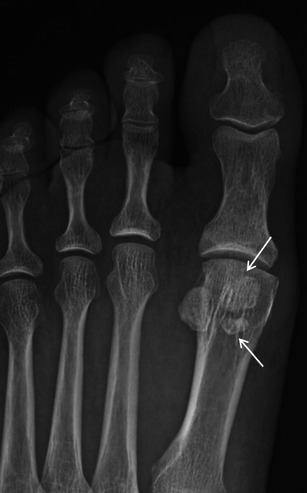
The other thing a sesamoid fracture is confused with is a bipartite sesamoid: a normal congenital variant where the sesamoid is naturally in two pieces, present in roughly 10–30% of people. The difference matters: a bipartite sesamoid is harmless and needs no treatment, while a true fracture needs offloading and time to heal. The two can look nearly identical on a single X-ray, and the distinction is the most common diagnostic question with sesamoid two-piece appearance, covered in detail below.
Two types of fracture
Acute fracture
A sudden, traumatic break, typically from:
- Landing forcefully on the ball of the foot from a jump or fall
- High-impact running on a hard surface
- A direct blow to the bottom of the big toe joint
- Forced extension of the big toe (similar mechanism to severe turf toe)
Stress fracture
A gradual fatigue fracture from repetitive load:
- High-mileage runners
- Dancers (especially ballet, en pointe)
- Athletes with rapid increases in training volume
- People with high arches (cavus foot), concentrates load on the sesamoids
How to distinguish from sesamoiditis
| Feature | Sesamoiditis | Sesamoid fracture |
|---|---|---|
| Onset | Gradual, dull ache | Sudden sharp pain (acute) or persistent sharp ache (stress) |
| Pain quality | Aching | Sharp, focal |
| Tenderness | Diffuse over sesamoid | Pinpoint over the bone |
| Healing time | Weeks to months | Months; sometimes 6–12 months for stress fractures |
| X-ray | Normal | May show fracture line; bipartite sesamoid can mimic |
Bipartite sesamoid: the most common mimic
A bipartite sesamoid is a normal anatomic variant in which the sesamoid bone forms in two (or sometimes three, tripartite) pieces rather than one. It is present in roughly 10–30% of people depending on the series, occurs more often in the tibial (medial) sesamoid than the fibular, and is bilateral in about 25–85% of cases. On a standard X-ray, a bipartite sesamoid can look strikingly like a fracture, so much so that telling them apart is one of the more common diagnostic pitfalls in foot radiology.
Features that suggest bipartite (normal variant) rather than fracture:
- Smooth, rounded, well-corticated edges at the split, fractures show sharp, irregular, non-corticated edges
- Total combined size larger than expected: the bipartite halves together are usually bigger than a normal single sesamoid
- No significant pain or tenderness when pressed directly over the sesamoid (although a bipartite sesamoid can develop its own painful problems)
- No clear history of acute injury or escalating overuse
A practical clinical tip: because bipartite sesamoids are bilateral in a large minority of patients, comparing an X-ray of the other foot can help confirm the diagnosis. If the contralateral foot shows the same bipartite pattern, the appearance on the symptomatic side is more likely to be a normal variant than a fracture. (The reverse is not absolute, a unilateral bipartite is still possible, so a symptomatic patient with X-ray findings still needs careful clinical correlation, and MRI when in doubt.)
When the X-ray is genuinely ambiguous, MRI is the most useful next step. A true acute fracture shows bone marrow edema across the line; a quiet bipartite sesamoid does not. A symptomatic bipartite sesamoid (sometimes called bipartite sesamoiditis, where the cartilaginous junction between the two parts becomes inflamed or disrupted) can show edema too, at which point the management overlaps with sesamoiditis and stress fracture care.
How to recognize it
- Sharp, focal pain under the big toe joint
- Pain with push-off, especially during running or walking on hard surfaces
- Tenderness directly over the affected sesamoid
- Swelling and possible bruising under the joint
- Painful big toe extension (bending the toe up stretches the tendon and sesamoid)
- Pain wearing high heels (loads the sesamoid)
- Limp in acute cases
Diagnosis
- History and exam: pinpoint tenderness over the sesamoid, pain with toe extension
- X-rays: including standard views and a sesamoid axial view which best shows the bones. Compare to the other foot if needed
- MRI: gold standard. Shows fracture, bone marrow edema, and helps distinguish from bipartite sesamoid or sesamoiditis
- Bone scan or CT: sometimes used in stress fracture cases
Treatment
Conservative care (most cases)
The sesamoids’ poor blood supply means healing is slow. Treatment focuses on complete unloading of the sesamoid:
- Walking boot or stiff-soled rocker shoe for 6–8 weeks
- Carbon fiber turf toe plate to limit big toe extension
- Sesamoid pad / J-pad orthotic to offload the affected bone
- Activity modification: no running, jumping, or pivoting until cleared
- Crutches in the early phase if pain is severe
- NSAIDs for inflammation
- Bone stimulator: sometimes used in stress fractures with delayed healing
- Imaging follow-up at 6–8 weeks to confirm healing
Healing time:
- Acute fractures: typically 6–12 weeks
- Stress fractures: typically 3–6 months, occasionally 6–12
- Some cases progress to avascular necrosis (bone death) requiring different management
Surgery
Considered for fractures that don’t heal with prolonged conservative care, or for displaced fractures with poor alignment:
- Sesamoidectomy: removal of the affected sesamoid. Reliable for pain relief
- Bone graft / fixation: preservation surgery, less common but used in selected cases
- Recovery: 6–8 weeks in a boot; full recovery 3–6 months
Removing both sesamoids is generally avoided; it can cause secondary big toe deformity. Single sesamoidectomy is generally well tolerated.
Bottom line
A sesamoid fracture is slow to heal, easy to confuse with sesamoiditis or a bipartite sesamoid, and benefits from early protected weight-bearing. MRI is the most useful imaging test for confirming the diagnosis. Most cases heal with patient conservative care; persistent pain points to sesamoidectomy. Athletes should expect 3–6 months for full return to sport, trying to push through is the most common cause of progression to avascular necrosis.
Frequently asked questions
What is a sesamoid fracture?
A sesamoid fracture is a break in one of the two small bones (about the size of a corn kernel each) embedded in the tendons beneath the big toe joint. The medial sesamoid (tibial sesamoid) is fractured more often than the lateral (fibular). Fractures happen from a single high-force injury (a fall, jump, or stomp landing forefoot-first) or from repetitive overload (stress fracture pattern). Both kinds cause sharp pain under the ball of the foot at the base of the big toe.
Sesamoid fracture vs sesamoiditis, what's the difference?
Sesamoiditis is inflammation of the sesamoid bones and surrounding soft tissue from overuse, common in runners, dancers, and people who spend long periods on the balls of their feet. A sesamoid fracture is an actual break in the bone. The symptoms overlap significantly. The distinguishing test is an X-ray: a fresh fracture line is visible, while sesamoiditis usually shows a normal bone (or sometimes a bipartite sesamoid, which is a normal anatomical variant, not a fracture).
How long does a sesamoid fracture take to heal?
6 to 12 weeks for most cases, sesamoids have a notoriously slow healing pace because of their small size and limited blood supply. Initial treatment is typically a walking boot or cast for 4–6 weeks, followed by a stiff-soled shoe and offloading insert for several more weeks. Recurrent pain or non-union (failure to heal) happens in a meaningful minority of cases and can require either continued conservative care or surgical sesamoidectomy.
Bipartite sesamoid vs sesamoid fracture, how do they look different?
A bipartite sesamoid is a normal variant in which one sesamoid is naturally divided into two parts, present in roughly 10–30% of people and usually painless. The dividing line is smooth, well-corticated, and rounded on X-ray. A fresh fracture line is irregular, sharp-edged, and not corticated. When the appearance is ambiguous, comparison X-rays of the opposite foot help (bipartite sesamoids are often bilateral), and MRI can definitively distinguish acute fracture from a long-standing bipartite.
Do I need surgery for a sesamoid fracture?
Most sesamoid fractures heal with conservative care: protected weight-bearing in a boot, gradual return to a stiff-soled shoe, offloading insert, and patience. Surgery (partial or complete sesamoidectomy) is considered when pain persists for 6+ months despite proper conservative care, when the fracture clearly hasn't healed on imaging, or when there's significant arthritic change. Removing a sesamoid alters big-toe push-off mechanics, so it's not a first-line option.
Sources
Last updated: July 16, 2026

About the author
Written and reviewed by a Doctor of Podiatric Medicine (DPM) practicing in Arizona for 6+ years. Board-certified by the American Board of Podiatric Medicine (ABPM); graduate of Midwestern University Arizona College of Podiatric Medicine.
Last clinically reviewed: July 16, 2026