What it is
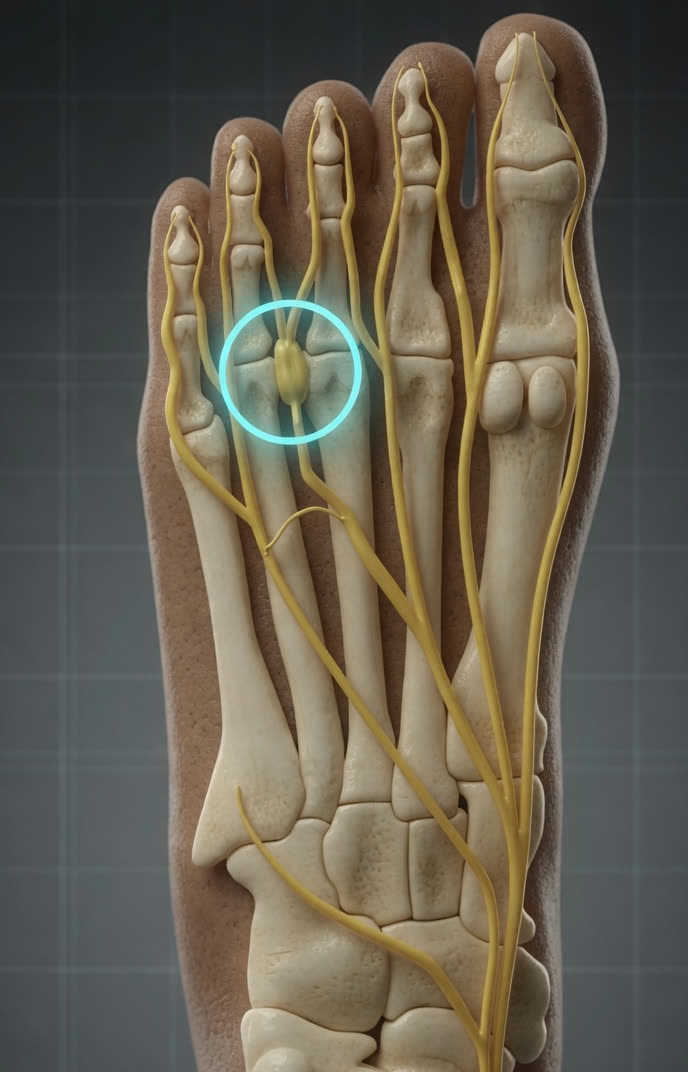
A foot neuroma is benign thickening of tissue around a small nerve in the foot. The nerve becomes irritated and enlarged from repeated compression, producing burning, tingling, electric-type pain. Despite the name, it isn’t a true tumor, the “neuroma” refers to nerve tissue that has thickened and become hyper-sensitive in response to chronic irritation.
The most familiar form is Morton’s neuroma, which classically develops in the third web space (between the third and fourth toes). But the same kind of compressive nerve irritation can develop:
- In the second web space (between the second and third toes), sometimes called a Hauser neuroma
- In the first or fourth web space less commonly
- In the digital nerve before it has thickened into a true neuroma: this earlier stage is often called interdigital neuritis and presents the same way clinically; the distinction matters mostly for imaging and prognosis, not for early treatment
- Occasionally in multiple web spaces in the same foot
Because the symptoms and conservative treatment are very similar across these locations, this page covers them together. The classic third-web-space Morton’s neuroma is the most common pattern, but a clinician may diagnose neuroma or neuritis at a different location after examining your foot.
Symptoms
People often describe the sensation in vivid terms:
- Burning or electric pain in the ball of the foot, radiating into one or both adjacent toes
- A feeling of standing on a pebble or having a sock bunched under the foot
- Numbness or tingling in the affected toes
- Pain that worsens with walking, especially in tight shoes
- Relief when removing shoes and massaging the foot
Symptoms can come and go for months before becoming constant. The exact toes affected give a clue to which nerve is involved, pain into the third and fourth toes points to the third-web-space (“classic” Morton’s), pain into the second and third toes to the second web space, and so on.
What causes it
The nerve gets pinched between the metatarsal bones. Anything that increases that compression can contribute:
- Tight or pointed shoes that squeeze the forefoot
- High heels that shift body weight forward onto the ball of the foot
- Repetitive impact: running, racquet sports, dance
- Foot deformities like bunions, hammertoes, or flat feet
- Trauma to the forefoot
Women are roughly 8 times more likely to develop Morton’s neuroma than men, largely attributed to footwear patterns.
Treatment options
Treatment is staged, start conservative, escalate if needed. The nerve doesn’t shrink, but symptoms can be managed effectively in most cases.
Conservative
- Wider, lower shoes with a roomy toe box and low heel, the single most important change
- Metatarsal pads placed just behind the ball of the foot to spread the bones and offload the nerve
- Custom orthotics to support the arch and reduce forefoot pressure
- Activity modification: temporary reduction in high-impact activity
- Ice and NSAIDs for flare-ups (a topical NSAID or lidocaine can take the edge off, though a neuroma needs more than a cream)
- Toe spacers and stretches for foot mobility
When conservative care isn’t enough
- Corticosteroid injections: can reduce inflammation around the nerve and provide weeks to months of relief
- Alcohol sclerosing injections: chemically dehydrate the nerve in a series of treatments
- Cryoneurolysis: freezes the nerve to interrupt pain signals
- Radiofrequency ablation: uses heat to disrupt the nerve
Surgical
If injections and footwear changes fail after 6–12 months, surgery may be considered. Options include nerve decompression (releasing the ligament pressing on the nerve) or neurectomy (removing the affected portion of the nerve). The latter can leave permanent numbness in the affected toes but reliably relieves pain.
When to see a clinician
See a clinician if you have:
- Persistent burning, tingling, or numbness in the toes
- Pain that limits walking, exercise, or shoe choice
- Symptoms lasting more than a few weeks despite shoe changes
- Worsening despite conservative care
Diagnosis is usually clinical, a clinician can often reproduce the pain with specific exam maneuvers. Imaging (ultrasound or MRI) is sometimes used to confirm or rule out other causes.
Living with it
Footwear changes do most of the work. People who switch to wide, low shoes, even when they don’t love how they look, often report dramatic improvement. Reserve narrower or heeled shoes for short occasions, not all-day wear.
Frequently asked questions
What does Morton's neuroma feel like?
The classic description is 'a pebble in my shoe' or 'sock bunched up under the toes', a sense of something there that isn't. Most people also report burning, sharp, or electric pain in the ball of the foot, often radiating into the third and fourth toes. Symptoms typically worsen with tight shoes and improve when shoes come off.
Will Morton's neuroma go away on its own?
Sometimes mild cases improve with footwear changes alone, wider shoes, lower heels, and metatarsal pads. Established neuromas don't typically resolve completely without treatment, but symptoms can be well-controlled. Untreated, they tend to gradually worsen.
Do cortisone injections help Morton's neuroma?
Often yes, but be realistic about how long it lasts. A cortisone injection reliably helps in the short term, with relief peaking somewhere between the first week and about three months. The honest part most sources skip: the benefit commonly fades after that, pooled data put sustained success at roughly a third of patients, and in one systematic review about 30% eventually went on to surgery anyway. That doesn't make the injection pointless: it buys a genuine window and helps confirm the diagnosis. It just isn't usually a permanent fix. Multiple injections can weaken surrounding tissue and aren't typically repeated more than 2–3 times per year. Alcohol sclerosing injections are an alternative for chronic cases.
What are the best shoes for Morton's neuroma?
Wide toe box, low heel (no more than ~1 inch), soft uppers, and metatarsal pads inside the shoe to spread the metatarsal heads and take pressure off the nerve. Avoid pointed shoes, high heels, and tight-laced athletic shoes. Brands with anatomical toe boxes (Altra, some New Balance models, Topo) work well for many people.
Does Morton's neuroma require surgery?
No, most cases are managed without surgery. Conservative treatment (footwear, metatarsal pads, NSAIDs, sometimes injections) controls symptoms in 60–80% of patients. Surgery (neurectomy, removal of the nerve segment) is reserved for those who fail conservative care over 6–12 months. Surgery has high success rates but typically leaves a small numb area between the toes.
How is Morton's neuroma diagnosed?
Mostly by physical exam, the clinician squeezes the foot from side to side and may feel a click (Mulder's sign). Ultrasound or MRI confirms the diagnosis when needed. X-rays are typically normal but help rule out other causes like stress fracture or MTP capsulitis. A surface lesion that mimics neuroma pain: porokeratosis plantaris discreta (PPD), can also cause focal, disproportionate forefoot pain and is ruled out on visual inspection of the sole.
Sources
Last updated: July 16, 2026

About the author
Written and reviewed by a Doctor of Podiatric Medicine (DPM) practicing in Arizona for 6+ years. Board-certified by the American Board of Podiatric Medicine (ABPM); graduate of Midwestern University Arizona College of Podiatric Medicine.
Last clinically reviewed: July 16, 2026