Quick answer
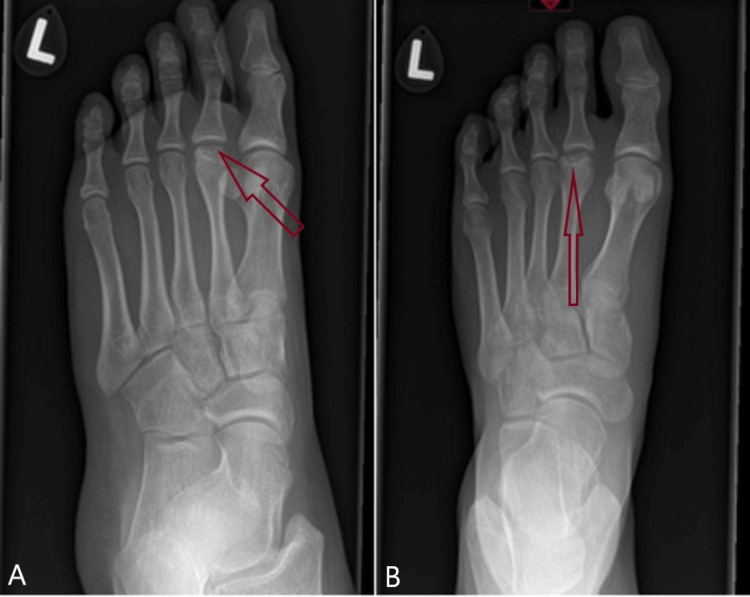
Freiberg’s disease is a form of osteonecrosis (bone death from interrupted blood supply) affecting the head of a metatarsal, most often the second metatarsal. The bone weakens, and over time the joint surface collapses, causing pain and stiffness at the ball of the foot. It typically presents in adolescents (especially active girls) but can be diagnosed at any age.
What’s actually happening
The blood supply to the metatarsal head comes from a few small arteries. When that supply is interrupted, either from a single traumatic event or chronic repetitive stress, the bone in the head dies. Without living bone to support it, the joint surface gradually collapses under load.
Stages of progression:
- Avascular event: the blood supply is interrupted
- Subchondral bone death: bone beneath the cartilage dies
- Collapse: the joint surface caves inward
- Cartilage damage: the once-smooth joint becomes irregular
- Late changes: loose bodies, joint enlargement, secondary arthritis
The exact trigger is often unclear. Theories include:
- Repetitive microtrauma: common in dancers, athletes, runners
- A long second metatarsal: bears excess load, more vulnerable
- Acute trauma in some cases
- Hormonal factors: explains the female predominance and adolescent onset
- Vascular anomalies in some patients
How to recognize it
- Pain at the ball of the foot under the affected metatarsal (usually the second)
- Worse with weight bearing, especially push-off
- Worse barefoot on hard surfaces
- Stiffness in the affected toe
- Swelling at the base of the toe
- Sometimes a palpable bony enlargement in advanced cases
- Reduced range of motion in the affected MTP joint
- Frequently misdiagnosed initially: see the differential diagnosis section below
In adolescents, the typical story is a young dancer or athlete with persistent forefoot pain that doesn’t improve with rest.
The Smillie staging system
Freiberg’s disease is staged from I (mild) to V (severe):
- Stage I: fissure fracture, no deformity yet
- Stage II: collapse begins on the dorsal aspect
- Stage III: further collapse, joint surface flattening
- Stage IV: loose bodies, central plantar fragment
- Stage V: flattened metatarsal head, secondary arthritis
Earlier stages often respond to conservative care; later stages typically need surgery.
Differential diagnosis: what else this could be
Forefoot pain under a lesser metatarsal head is a symptom with many possible causes. Freiberg’s is one of the less common explanations, and it’s frequently mistaken for, and frequently mistakes itself for, these alternatives:
- Stress fracture of the metatarsal, also activity-related, also worse with weight-bearing, also often X-ray-negative early. MRI distinguishes them.
- Morton’s neuroma: burning or electric pain between toes (not directly under the metatarsal head), with toe numbness or tingling. Easily confused with Freiberg’s by location.
- Interdigital neuritis: irritation of the digital nerve before it becomes a true neuroma; similar burning/tingling pattern
- MTP capsulitis: inflammation of the joint capsule; tenderness on the plantar side of the MTP, sometimes with toe drift
- Plantar plate tear: partial or complete tear of the plantar capsule of the MTP joint, often with a “drifting” or “floating” toe
- Metatarsalgia (mechanical, fat-pad atrophy), diffuse pain under the ball of the foot from overload, not a discrete bony problem
- Arthritis at the MTP joint, degenerative, inflammatory (rheumatoid, psoriatic), or post-traumatic
- Sesamoiditis / sesamoid fracture: when the pain is under the first metatarsal head specifically
- Gout or pseudogout: acute inflammatory crystal arthritis presenting at the MTP
- Porokeratosis plantaris discreta (PPD): a small, deep, disproportionately painful keratotic lesion sitting directly under a metatarsal head; commonly mistaken for a callus and easily confused with Freiberg’s on history alone. Visual inspection of the sole differentiates them.
Because the differential is wide and several of these have overlapping symptoms, MRI is usually the test that resolves the picture when X-rays are normal or ambiguous in a young patient with persistent forefoot pain. Empiric treatment without imaging is the most common reason a Freiberg’s diagnosis is missed for months at a time.
Diagnosis
- Physical exam: tenderness directly over the metatarsal head, swelling, restricted MTP motion
- X-rays: show the changes once collapse begins. Early disease (Stage I) may have normal X-rays.
- MRI: most sensitive for early disease, shows bone marrow edema and avascular changes before X-ray changes appear
- Bone scan: sometimes used in early cases
Treatment
Conservative care (first-line for early-stage disease)
The goal is to offload the affected metatarsal head while the bone heals or stabilizes:
- Stiff-soled shoes or rocker-bottom shoes: limit motion at the painful joint
- Walking boot for 4–8 weeks for active disease
- Metatarsal pad placed behind the affected metatarsal head
- Custom orthotics with metatarsal padding for chronic management
- Activity modification: reduce running, jumping, dancing
- NSAIDs for symptoms
- Avoid corticosteroid injections: can worsen necrosis
Many adolescent cases caught early respond well to conservative care over months.
Surgery
For advanced disease or cases that fail conservative care:
- Joint debridement: arthroscopic or open removal of loose bodies and damaged cartilage. Reasonable for moderate disease.
- Dorsal closing wedge osteotomy: rotates the more intact plantar cartilage upward into the joint. Effective for Stage III–IV disease.
- Metatarsal head resection: removal of the metatarsal head; reserved for severe end-stage cases. Can cause transfer pain to adjacent metatarsals.
- Metatarsal head implant: newer option, mixed evidence.
- Joint fusion: last resort, rarely needed.
Recovery from surgery typically 8–12 weeks for return to most activities.
Bottom line
Freiberg’s disease is an uncommon but important cause of forefoot pain, particularly in adolescents and young adults. Early recognition matters because conservative care is far more effective in the early stages, before joint collapse. Persistent pain at the ball of the foot under the second toe, especially in a teenage athlete or dancer, deserves an MRI if X-rays are normal to look for this diagnosis.
Sources
Last updated: July 16, 2026

About the author
Written and reviewed by a Doctor of Podiatric Medicine (DPM) practicing in Arizona for 6+ years. Board-certified by the American Board of Podiatric Medicine (ABPM); graduate of Midwestern University Arizona College of Podiatric Medicine.
Last clinically reviewed: July 16, 2026