
Quick answer
Gout is an inflammatory arthritis caused by the buildup of monosodium urate crystals in joints. Attacks come on suddenly, often overnight, with intense pain, redness, swelling, and warmth. The big toe joint (the first MTP) is the classic location (“podagra”), but ankles, midfoot, knees, and other joints can also be affected. Acute attacks are dramatically painful but resolve with treatment; the long-term goal is to lower the uric acid level enough that crystals no longer form.
How to recognize an acute attack
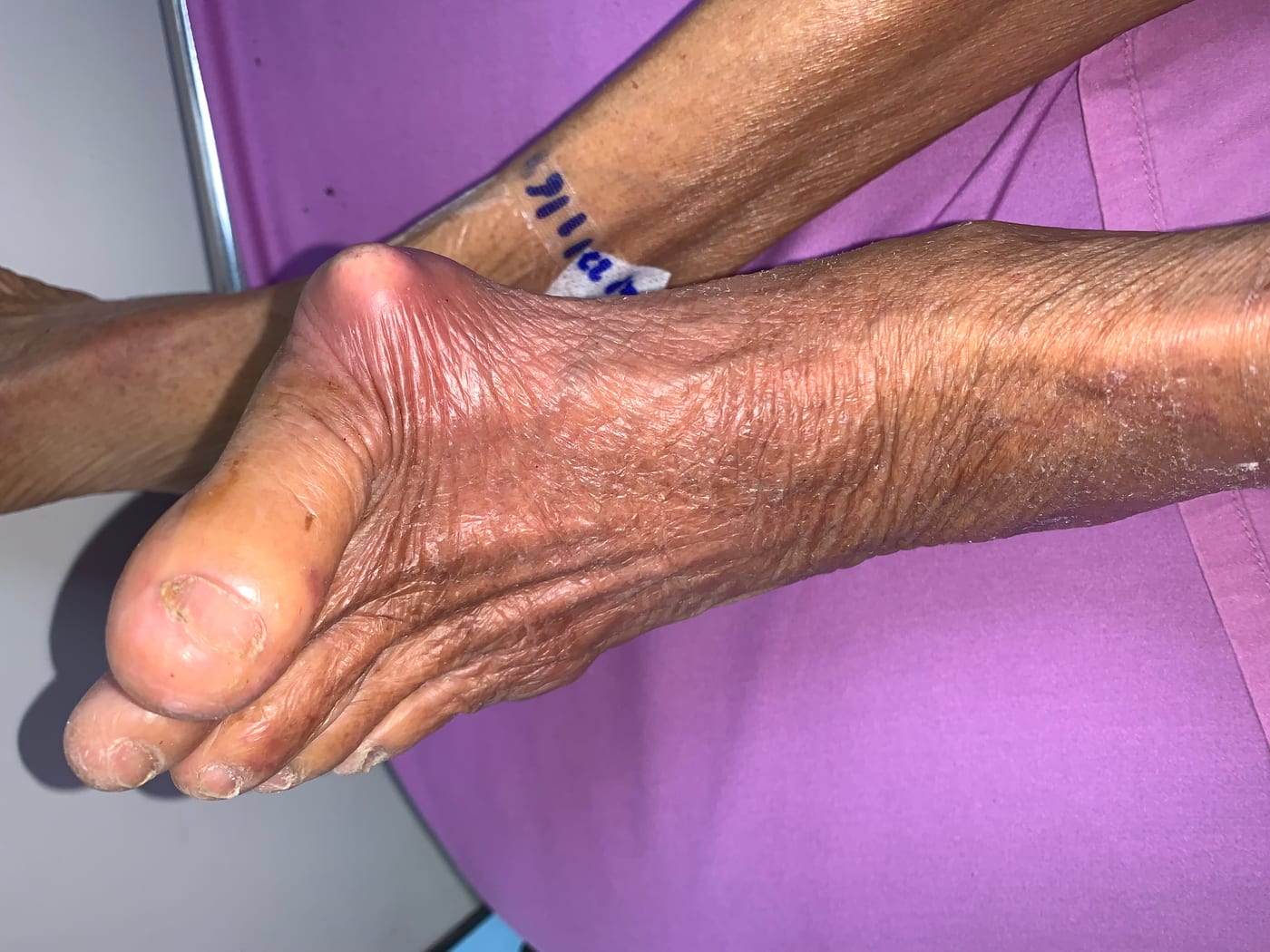
The classic gout attack is unmistakable to anyone who has had one:
- Sudden onset, often waking the patient from sleep
- Intense pain: often described as the worst pain of the patient’s life
- Hot, red, swollen, exquisitely tender joint
- Even the weight of a bedsheet is intolerable
- Peaks within 12–24 hours
- Resolves over 7–14 days even without treatment
- Most often the big toe (first MTP joint), affected in ~50% of first attacks
- Can also affect the midfoot, ankle, knee, wrist, fingers
- Usually one joint at a time in early disease; multiple joints possible later
In early disease, attacks are separated by months or years of normal-feeling joints. Without treatment, attacks become more frequent, last longer, and involve more joints over time.
Why this happens
Uric acid is a normal byproduct of breaking down purines: substances found in many foods and produced by normal cell turnover. When uric acid levels in the blood get too high (hyperuricemia), it can crystallize in joints, especially in cooler peripheral joints like the big toe.
The crystals trigger a powerful inflammatory response, attracting white blood cells that release chemicals causing the dramatic pain and swelling.
Risk factors:
Non-modifiable
- Male sex: about twice as common in men (5.2% vs 2.7% of US adults)
- Increasing age
- Genetics: strong family component
- Postmenopausal status in women: estrogen is protective; women’s risk rises after menopause
Medical conditions
- Kidney disease: impaired uric acid excretion
- Hypertension
- Obesity
- Metabolic syndrome and diabetes
- Heart failure
- Psoriasis and other high-cell-turnover conditions
Medications
- Diuretics (especially thiazides), major contributor
- Low-dose aspirin
- Cyclosporine and tacrolimus (transplant medications)
- Niacin
Diet and lifestyle
- Alcohol: beer is the worst offender; spirits second; wine has a smaller effect
- High-fructose foods and drinks: sodas, sweetened juices
- Red meat: particularly organ meats
- Shellfish: anchovies, sardines, mussels, scallops
- Dehydration
Other triggers
- Sudden change in uric acid (up or down) can trigger an attack, including the start of urate-lowering therapy
- Surgery, illness, dehydration
Diagnosis
The gold standard is identifying urate crystals in joint fluid:
- Joint aspiration: a small needle removes a few drops of fluid; needle-shaped, negatively birefringent crystals under polarized microscopy confirm gout
- Also rules out septic arthritis: a critical alternative that looks similar but is a medical emergency
Other helpful tests:
- Serum uric acid level: usually elevated, but can be normal during an acute attack
- X-rays: typically normal in early disease; may show “punched-out” erosions in chronic gout
- Ultrasound: can show the “double contour sign” of crystal deposits on cartilage
- Dual-energy CT (DECT): directly visualizes urate deposits; available in some centers
The look-alike: pseudogout (CPPD)
Acute pseudogout (CPPD) can look identical to gout, sudden hot, red, swollen, tender joint, but it’s caused by a different crystal (calcium pyrophosphate, not urate), tends to affect different joints (knee and wrist most often, but the ankle and midfoot in the foot), and has fundamentally different long-term management. Allopurinol doesn’t work for pseudogout. Joint aspiration with polarized microscopy distinguishes them, and it’s worth doing rather than assuming, especially when the attack pattern doesn’t quite fit classic podagra.
When to take it seriously
While gout is “usually” gout, the same symptoms can be caused by septic arthritis: a joint infection that’s a medical emergency. Features that should prompt urgent evaluation:
- Fever or chills
- Multiple joints affected at once in early disease
- First-time attack (deserves a clinical evaluation to confirm diagnosis)
- Atypical joint for gout, shoulder, hip, spine
- Failure to improve with usual gout treatment
- Any concern for skin breakdown over the joint
Joint aspiration is often needed to distinguish gout from infection.
Treatment
Acute attack: treat the inflammation
Started as early as possible:
- NSAIDs: naproxen, indomethacin, others. Standard first-line for many. Avoid in patients with kidney disease, GI issues, heart failure, or on blood thinners.
- Colchicine: works best within the first 24–36 hours of an attack. Lower-dose protocols are now standard (specific dosing is determined by your clinician).
- Corticosteroids: oral (prednisone) or intra-articular (cortisone injection). First-line for patients who can’t take NSAIDs or colchicine.
- Ice to the affected joint
- Rest and elevation
- Starting urate-lowering medication during an attack: clinicians traditionally waited for the flare to settle first, but current rheumatology guidance (ACR 2020) supports starting during a flare with anti-inflammatory cover; it doesn’t prolong the attack. Either way, if you’re already on urate-lowering medication, keep taking it through the flare.
Most attacks resolve within 7–14 days with treatment.
Long-term: urate-lowering therapy
After repeated attacks, the goal shifts to preventing future ones by lowering uric acid below the saturation point (typically <6 mg/dL).
When to start urate-lowering therapy
- 2 or more attacks per year
- Tophi (visible urate deposits)
- X-ray erosions from gout
- Kidney stones from uric acid
- Chronic kidney disease plus elevated uric acid
Medications
- Allopurinol: first-line; reduces uric acid production. Started at a low dose and titrated upward based on uric acid levels and tolerability.
- Febuxostat: alternative when allopurinol isn’t tolerated
- Probenecid: increases uric acid excretion; less commonly used
- Pegloticase: IV biologic for severe refractory gout
Important: prophylaxis when starting
When urate-lowering therapy begins, the changing uric acid level can trigger attacks. Concurrent prophylaxis with low-dose colchicine or NSAIDs for 3–6 months is standard practice.
Diet and lifestyle changes
Diet alone won’t control gout in most patients, but it helps:
- Limit alcohol: especially beer
- Reduce high-fructose drinks and sweetened beverages
- Limit organ meats and shellfish
- Encourage low-fat dairy: appears protective
- Encourage cherries and cherry juice: modest benefit
- Coffee: appears protective
- Stay well-hydrated
- Maintain a healthy weight: weight loss lowers uric acid
- Treat associated conditions: hypertension, diabetes, kidney disease
Diet changes can lower uric acid by ~1 mg/dL, significant but usually not enough alone. Most patients with established gout need medication.
Tophaceous gout
In long-standing untreated gout, urate crystals form visible deposits called tophi under the skin, often around the big toe, fingers, or ear. Tophi can be:
- Cosmetic concerns
- Painful
- Erosive: destroying joints and bones over time
- Prone to ulceration and infection
Tophi can shrink and even resolve with adequate, sustained urate-lowering therapy, sometimes taking years.
Bottom line
Gout is one of the most treatable forms of arthritis. Acute attacks respond reliably to NSAIDs, colchicine, or steroids. The bigger question is whether to start long-term urate-lowering therapy, typically appropriate after 2 or more attacks per year, or with any tophi or erosions. With proper urate-lowering therapy reaching target levels, attacks become rare and joint damage stops progressing. The main pitfall is patients stopping their medication when they feel well, uric acid rises again, and attacks return.
Sources
- FitzGerald JD, Dalbeth N, Mikuls T, et al. 2020 American College of Rheumatology Guideline for the Management of Gout. Arthritis Care & Research ↗
- Menon SG, Rednam M, Gujarathi R, Maher L. Gout. StatPearls (updated 2026) ↗
- Chen-Xu M, Yokose C, Rai SK, Pillinger MH, Choi HK. Contemporary Prevalence of Gout and Hyperuricemia in the United States. Arthritis & Rheumatology (2019) ↗
Last updated: July 16, 2026

About the author
Written and reviewed by a Doctor of Podiatric Medicine (DPM) practicing in Arizona for 6+ years. Board-certified by the American Board of Podiatric Medicine (ABPM); graduate of Midwestern University Arizona College of Podiatric Medicine.
Last clinically reviewed: July 16, 2026