
Quick answer
Köhler’s disease is a temporary disruption of blood flow to the navicular bone in young children, a form of avascular necrosis (bone cell death from lack of blood supply). The condition is self-limited: the navicular almost always reforms completely over 1–3 years with conservative care, and most children grow up with normal foot function. The classic patient is a 5-year-old boy with a limp and tenderness on the inside of the midfoot, without a clear injury.
What’s actually happening
The navicular bone has a relatively delicate blood supply. In some children, mechanical or developmental factors (the navicular is the last tarsal bone to ossify: turn into hard bone) lead to a brief disruption of its blood supply. The bone cells partially die, the bone temporarily becomes denser and smaller on imaging, and then the bone gradually reforms with new blood supply over months to years.
The exact cause isn’t known, but the timing, when the navicular is ossifying, is thought to make it temporarily vulnerable.
How to recognize it
- Limp in a young child, often the only symptom early on
- Pain on the inner side of the midfoot, usually mild but persistent
- Walking on the outside of the foot to avoid pressure on the inner side
- Mild swelling over the navicular bone in some cases
- Tenderness when pressing over the navicular
- Symptoms that worsen with activity and improve with rest
- Often no clear injury: the parents can’t recall a specific event
The condition is usually unilateral (one foot), though bilateral cases occur.
Diagnosis
- History and exam: focal tenderness over the navicular plus a limp in the right age group is suggestive
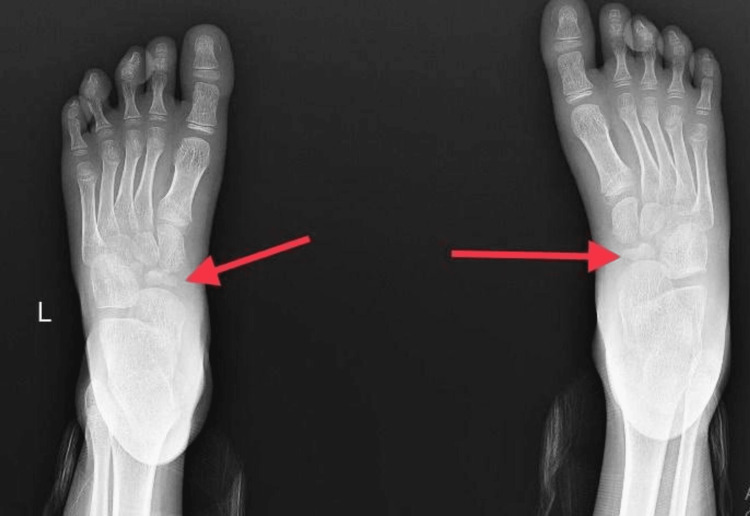
- X-rays: show flattening, sclerosis, and fragmentation of the navicular bone. The classic appearance is a “coin-on-edge” navicular, the bone looks dense and compressed
- MRI: sometimes obtained for unclear cases; shows decreased perfusion early on
- Bone scan: historical use; rarely needed today
- Differential diagnosis: must rule out fracture, infection, inflammatory arthritis, and accessory navicular pathology
Treatment
Köhler’s disease is one of the most rewarding pediatric foot conditions to treat because the prognosis is excellent and treatment is conservative.
Standard care
- Short-leg walking cast for 6–8 weeks: speeds resolution of pain. This is the most consistently effective treatment. Many studies show casted children resolve symptoms in roughly half the time of children treated only with activity modification
- Activity modification: children who don’t tolerate casting can often be managed with limited activity, supportive shoes, and over-the-counter arch support
- NSAIDs as needed for discomfort
- Soft arch support orthotics during recovery to offload the navicular
- Reassurance for parents, the bone reforms, and long-term outcomes are excellent
Symptoms typically resolve in 6–12 months; X-ray changes can persist for 2–3 years before the bone fully remodels.
Surgery
Almost never needed for true Köhler’s disease. Surgery is reserved for:
- Persistent symptoms after 1–2 years (rare)
- Cases that turn out to be misdiagnosed (e.g., undiagnosed accessory navicular pathology)
Long-term outlook
- Excellent prognosis: over 95% of children have a normal-functioning foot in adulthood
- No increased risk of adult navicular problems in most patients
- Bone reforms to normal or near-normal shape on long-term X-rays
- A small minority develop persistent stiffness or pain that may require evaluation later
Important: not the same as adult navicular AVN
A separate condition, Müller-Weiss disease: is avascular necrosis of the navicular in adults. It’s not the same disease as Köhler’s, doesn’t self-resolve the same way, and often requires more aggressive treatment. Don’t conflate them.
Bottom line
Köhler’s disease is a self-limited childhood condition with an excellent prognosis. The classic patient is a 5-year-old boy with a limp and inner-foot tenderness. Casting accelerates symptom relief but isn’t strictly necessary. Imaging may look scary, a fragmented, dense navicular, but the bone reforms. Reassurance plus conservative care is virtually always the right path.
Frequently asked questions
What is Kohler's disease?
Kohler's disease is a temporary loss of blood supply to the navicular bone (a small bone on the inner side of the midfoot) in children, usually ages 4 to 7. The affected portion of the bone temporarily softens, sometimes collapses partly, and then completely rebuilds itself over the following 6–24 months. It's named for Alban Köhler, the German radiologist who described it in 1908. It's almost always self-limiting and leaves no long-term problems.
Will my child outgrow Kohler's disease?
Yes, Kohler's disease is self-limiting in essentially all cases. The bone heals and rebuilds completely. Most children are pain-free within a few months, and on follow-up X-rays the navicular looks normal by adolescence. There are no known long-term consequences for foot function, growth, or adult arch development.
Does Kohler's disease need a cast?
A short course of walking boot or cast (typically 4–8 weeks) can shorten the painful phase compared to activity modification alone. Whether to immobilize depends on how much pain the child is having, how much they're limping, and how active they are. Some children manage well with just a stiff-soled shoe and reduced running. The treating pediatric foot specialist or orthopedist will tailor the approach.
How is Kohler's disease different from Freiberg's disease?
Both are forms of childhood avascular necrosis in foot bones, but they affect different bones and different age groups. Kohler's disease involves the navicular bone in children ages 4 to 7, usually boys. Freiberg's disease involves the head of the second metatarsal in older children and adolescents, mostly girls. Kohler's almost always resolves completely; Freiberg's can leave permanent changes to the metatarsal head.
How is Kohler's disease diagnosed?
A child between 4 and 7 with a limp and tenderness over the inside of the midfoot, with a navicular bone that looks dense, fragmented, or flattened on plain X-ray, has Kohler's disease until proven otherwise. The clinical picture plus the X-ray is enough, MRI is rarely needed. The X-ray appearance is striking and easy to recognize once you've seen it.
Sources
Last updated: July 16, 2026

About the author
Written and reviewed by a Doctor of Podiatric Medicine (DPM) practicing in Arizona for 6+ years. Board-certified by the American Board of Podiatric Medicine (ABPM); graduate of Midwestern University Arizona College of Podiatric Medicine.
Last clinically reviewed: July 16, 2026