Quick answer
Equinus is restricted ability to bend the ankle upward (dorsiflexion). The foot can’t flex past neutral when the knee is straight. The most common cause is simple calf tightness. It’s often missed because it’s not painful itself, but it’s a hidden driver behind a long list of foot problems. Stretching usually fixes it; surgery is reserved for stubborn cases.
Why limited ankle motion matters
Walking normally requires at least 10 degrees of dorsiflexion with the knee straight. When you can’t get there, your foot has to compensate. Compensations include:
- Rolling the foot inward (overpronation)
- Pushing weight onto the forefoot earlier in stance
- Heel coming off the ground prematurely
- Toes gripping or hammering
- Knee hyperextending
- Lower back arching more
These compensations cause secondary problems over time. Equinus is a “silent” condition that produces noisy symptoms elsewhere.
Conditions equinus contributes to
- Plantar fasciitis: overloaded plantar fascia from chronic forefoot loading
- Achilles tendinitis: overworked, chronically tightened tendon
- Metatarsalgia: excess pressure on the ball of the foot
- Posterior tibial tendon dysfunction: accelerated arch collapse
- Bunions: chronic medial overload
- Flat feet (acquired): the foot rolls in to make up for missing motion
- Hammertoes: from chronic forefoot gripping
- Knee, hip, low back pain: kinetic chain effects
If you have multiple foot problems on the same side, or one stubborn problem that keeps coming back, equinus is worth checking.
How to test for it
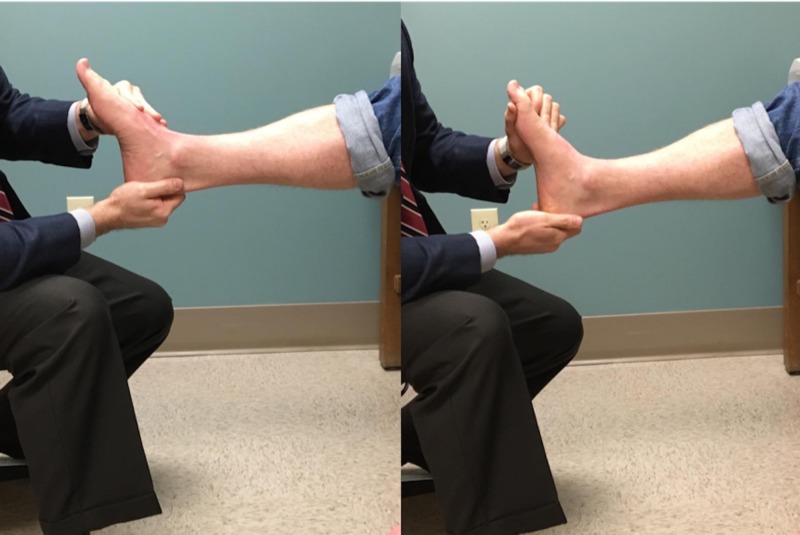
The Silfverskiöld test (don’t worry about the name; it’s just a clinical test):
- Sit with your knee straight and ankle relaxed
- Try to flex your foot up so your toes come toward your shin
- Then bend your knee 90 degrees and try again
The interpretation:
- Limited dorsiflexion both ways → soleus + gastrocnemius involved
- Limited only with knee straight → gastrocnemius alone (most common)
- Normal → no equinus
Most adults are surprised at how limited their dorsiflexion is when tested formally.
Causes
- Genetic / familial: some people are born with shorter calf-Achilles complex
- Sedentary lifestyle: sitting all day shortens the calves
- Heel-elevated shoes: high heels, cowboy boots, even slight heel lift in dress shoes
- Aging: connective tissues stiffen
- Prior ankle injury: scar tissue, bone block from prior fracture
- Diabetes: glycation stiffens collagen
- Cerebral palsy and other neurologic conditions
- Achilles tendon contracture after injury or surgery
Treatment
Stretching (the foundation)
The single most effective intervention. Two key stretches:
Straight-knee calf stretch (gastrocnemius):
- Stand facing a wall, hands on the wall
- Step one foot back, keeping that knee straight, heel down
- Lean forward until you feel a stretch in the upper calf
- Hold 30–60 seconds, repeat 3–5 times
- Both sides
Bent-knee calf stretch (soleus):
- Same setup, but bend the back knee slightly
- Stretch is felt lower in the calf
- Hold 30–60 seconds, repeat 3–5 times
Done 2–3 times per day for at least 6–8 weeks, this often produces meaningful improvement.
Other conservative measures
- Heel raises in shoes, partially compensate while stretching works
- Calf strengthening: eccentric heel drops also stretch
- Night splint: keeps the ankle dorsiflexed during sleep
- Physical therapy: for resistant cases, manual therapy plus structured stretching
- Lower-heel shoes for daily wear
- Custom orthotics: particularly for managing secondary conditions
When stretching isn’t enough
For cases that don’t respond to 4–6 months of dedicated stretching, particularly in the setting of recurrent secondary conditions:
Gastrocnemius recession (the Strayer procedure):
- Outpatient surgery
- Lengthens just the gastrocnemius portion of the calf
- Recovery: 2–6 weeks in a boot, full recovery 3–6 months
- High satisfaction in well-selected patients
Achilles tendon lengthening:
- More extensive procedure
- Reserved for severe equinus involving both gastrocnemius and soleus
- Higher complication rate; used selectively
When to see a clinician
- Recurring foot pain, particularly plantar fasciitis or Achilles issues, that doesn’t fully respond to standard treatment
- Multiple foot problems on the same side
- Difficulty squatting (a common test of ankle mobility)
- Heel coming off the ground when squatting
- Recent ankle injury that hasn’t fully recovered range of motion
- Children with toe-walking that isn’t resolving
Many cases are diagnosed incidentally when evaluating something else, a clinician notices limited dorsiflexion on exam.
Prevention
- Daily calf stretching: even just 5 minutes
- Limit heels for daily wear (occasional is fine)
- Don’t sit all day: stand and stretch periodically
- Address ankle injuries fully: return all motion before stopping rehab
- For runners: regular calf stretching maintains ankle range of motion; the evidence that stretching prevents running injuries in general is mixed, but in a runner with tight calves it addresses the specific deficit driving the problem
- Yoga, mobility work: addresses calf flexibility along with the rest of the body
Bottom line
If you have stubborn foot pain, especially of the heel or arch, and tight calves haven’t been part of the evaluation so far, equinus is worth considering. It’s treatable, often with stretching alone, and addressing it can resolve secondary problems that didn’t respond to other treatments.
Sources
Last updated: July 16, 2026

About the author
Written and reviewed by a Doctor of Podiatric Medicine (DPM) practicing in Arizona for 6+ years. Board-certified by the American Board of Podiatric Medicine (ABPM); graduate of Midwestern University Arizona College of Podiatric Medicine.
Last clinically reviewed: July 16, 2026