Quick answer
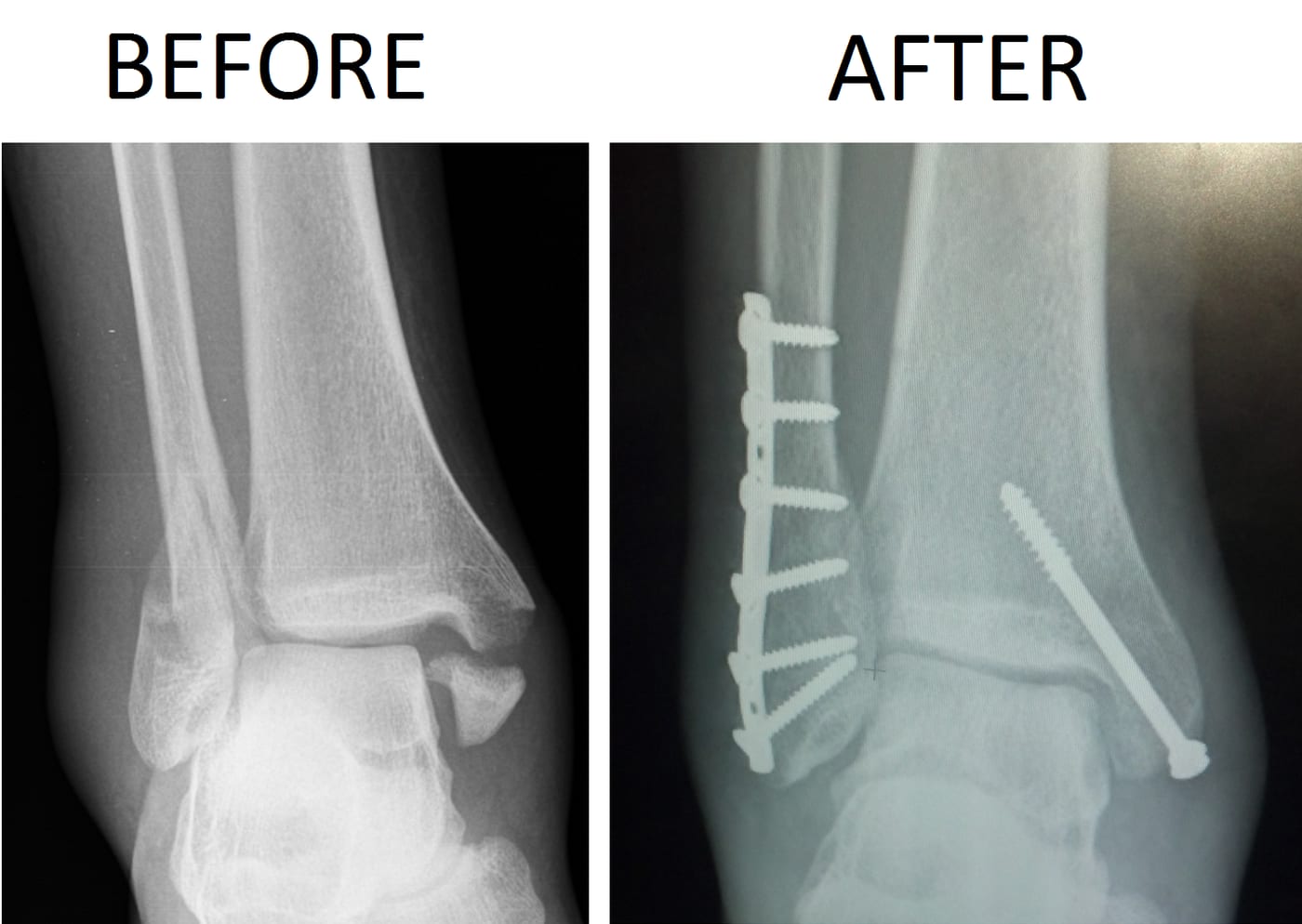
An ankle fracture is a break in one or more of the three bones that form the ankle joint: the tibia (shin), the fibula (the smaller bone on the outside), or the back edge of the tibia. The same twisting injury that causes a sprain can also cause a fracture, which is why fractures are often initially mistaken for severe sprains. The number of bones broken determines treatment: one bone fractures often heal in a boot; two or three usually need surgery.
How to recognize one
- Specific moment of injury: twisting the ankle, often with a “pop”
- Severe pain that’s typically worse than a sprain
- Inability or great difficulty bearing weight (can sometimes walk on a low-grade ankle fracture)
- Rapid swelling
- Bruising that develops over hours to days, often spreading
- Tenderness over a specific bone rather than diffuse soft tissue
- Visible deformity in displaced fractures
- Possible numbness or color change in advanced injuries
Anatomy of the ankle
Three bony parts make up the ankle joint:
- Medial malleolus: the inside ankle bone (end of the tibia)
- Lateral malleolus: the outside ankle bone (end of the fibula)
- Posterior malleolus: the back edge of the tibia
Plus the syndesmosis: a ligamentous connection between tibia and fibula above the ankle joint. Injury here (“high ankle sprain”) changes the picture even without a bony fracture.
Fracture types:
- Unimalleolar: one bone broken (often lateral). Many heal without surgery.
- Bimalleolar: two bones broken. Usually unstable; surgery typical.
- Trimalleolar: all three. Almost always unstable; surgery.
- Pilon fracture: high-energy crush injury through the bottom of the tibia. Severe.
When you need an X-ray (Ottawa Ankle Rules)
You probably need an X-ray if any of these are true:
- You can’t bear weight for 4 steps right after the injury or in the ER
- Bone tenderness on the back edge or tip of either malleolus
- Bone tenderness over the navicular or fifth metatarsal base (specific midfoot bones, the rules cover both ankle and foot)
The Ottawa Rules are 95%+ sensitive for fractures and reduce unnecessary X-rays substantially.
Treatment
Stable, non-displaced fractures (often single-bone)
- Walking boot for 6–8 weeks
- Weight-bearing as tolerated in many cases
- Physical therapy for range of motion and strength
- Gradual return to activity
- Healing typically 6–12 weeks
Unstable or displaced fractures
- Surgery (open reduction with internal fixation, ORIF): plates and screws to realign the bones
- Non-weight-bearing for 6–8 weeks typical
- Cast or boot for protection
- Physical therapy afterward
- Full recovery 4–6 months, sometimes longer
Pilon fractures
- High-energy injuries with significant soft tissue damage
- Often staged surgery: initial external fixation, definitive surgery once swelling decreases
- Long recovery (12+ months for full recovery)
- High rate of long-term arthritis
Recovery expectations
Realistic timeline for typical surgically treated ankle fracture:
- Weeks 0–6: non-weight-bearing in cast or boot, swelling and bruising resolve
- Weeks 6–12: gradual weight-bearing, physical therapy starts in earnest
- Months 3–6: full weight-bearing, return to most daily activities
- Months 6–12: return to running, sports, full strength
- Years: some stiffness and weather sensitivity often persist
- Late: risk of post-traumatic arthritis (roughly 20% after operatively treated fractures, higher for severe patterns)
For non-surgical fractures, the timeline is roughly half of the above.
When to see a clinician
Same day if:
- You can’t bear weight after a twisting injury
- Severe deformity is visible
- Bone tenderness on specific spots (Ottawa rules)
- Pain or numbness suggesting nerve or vascular involvement
- Open wound near the ankle
A “bad sprain” that doesn’t improve over a week of rest, ice, and elevation is worth getting X-rayed too, some fractures are subtle.
Prevention
- Adequate strength and balance: single-leg balance training reduces fall risk
- Address chronic ankle instability: repeat sprains predispose to fractures
- Appropriate footwear for the activity
- Calcium, vitamin D, weight-bearing exercise for bone health
- Fall prevention in older adults, home modifications, vision checks, medication review
- Don’t return to sports too early after a sprain, incomplete rehab raises future fracture risk
Sources
Last updated: July 16, 2026

About the author
Written and reviewed by a Doctor of Podiatric Medicine (DPM) practicing in Arizona for 6+ years. Board-certified by the American Board of Podiatric Medicine (ABPM); graduate of Midwestern University Arizona College of Podiatric Medicine.
Last clinically reviewed: July 16, 2026