
Quick answer
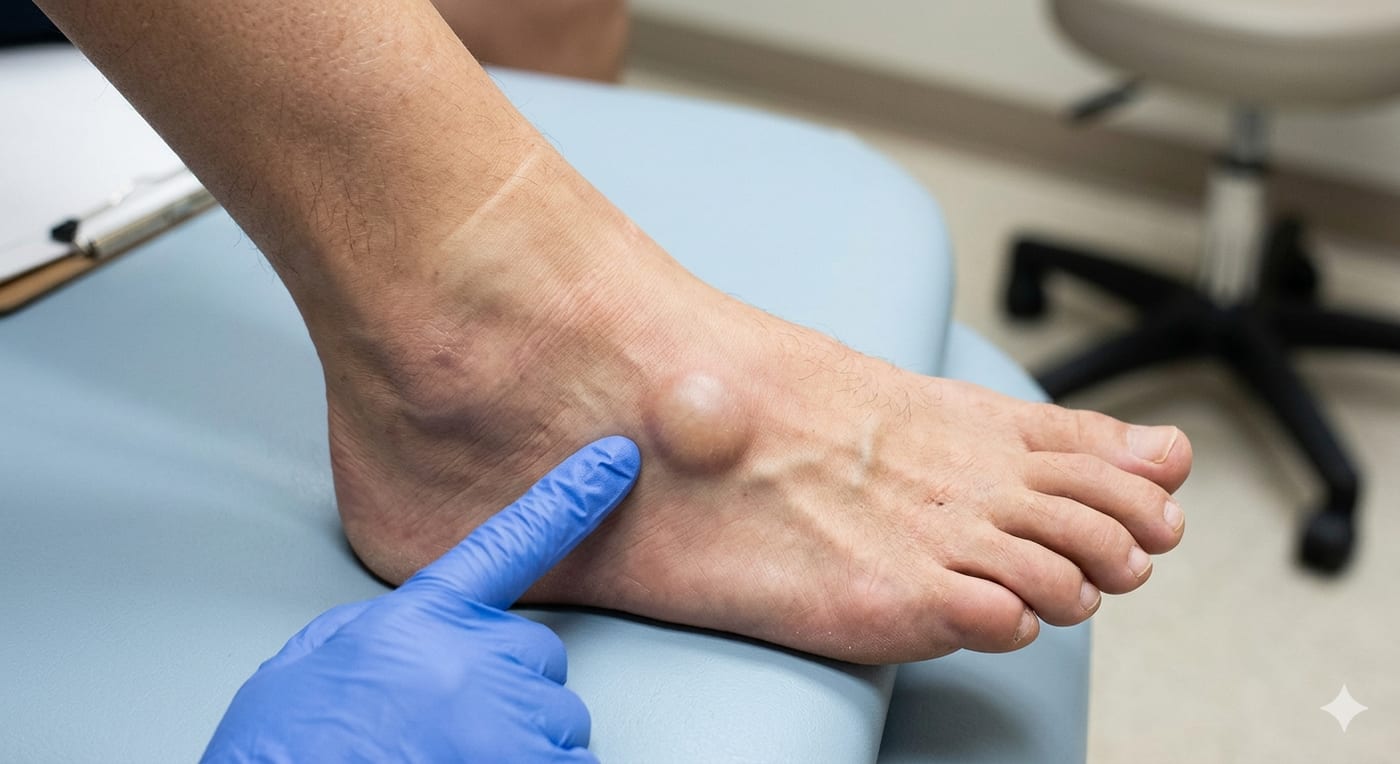
A ganglion cyst is a non-cancerous, fluid-filled sac that grows from the lining of a joint or tendon sheath. The fluid inside is gelatinous, similar to the natural lubricant of joints and tendons. The most common foot location is the dorsum (top), often near the midfoot or ankle. Many ganglion cysts are painless and only need treatment if they hurt, press on a nerve, or interfere with shoes.
What’s actually happening
The exact cause isn’t known, but the leading theory: a small defect in a joint capsule or tendon sheath allows synovial fluid to leak out into the surrounding tissue. The fluid becomes encapsulated and forms a one-way valve effect, fluid can move out of the joint but doesn’t easily return. The cyst grows slowly as fluid accumulates.
This is why ganglion cysts:
- Often change in size day to day or week to week
- Sometimes disappear and recur spontaneously
- Are typically firm and round
- Trans-illuminate when a light is shone through them (in contrast to solid masses)
How to recognize it
- A round, firm lump on the foot, most often on top of the midfoot or near the ankle
- Slow growth over weeks to months
- Size variability: bigger after activity, smaller with rest
- Often painless, but can cause pain when:
- Pressing on a nearby nerve
- Rubbing against shoes
- Limiting movement of an adjacent joint
- Smooth and rubbery to the touch, not hard like bone or tender like an infection
- Doesn’t move with the skin: attached to deeper structures
- Skin over it looks normal: no redness, warmth, or color change
Common locations on the foot
- Dorsum (top) of the midfoot: most common location, often near the cuneiforms
- Anterior ankle: over the joint line
- Lateral ankle: sometimes near the peroneal tendons
- Plantar surface: less common; can be more bothersome because of weight bearing
- Near the toe joints: sometimes confused with arthritis nodules
Diagnosis
Most ganglion cysts can be diagnosed by exam alone:
- Physical exam: round, firm, mobile mass with characteristic feel
- Trans-illumination: shining a light through the cyst confirms fluid content
- Ultrasound: quick, non-invasive; confirms the cystic (fluid) nature and rules out solid masses
- MRI: used when the diagnosis is unclear or the location is unusual; also useful for assessing relationship to nerves and tendons before surgery
- Aspiration: drawing fluid out through a needle; the gelatinous fluid is highly characteristic
Treatment
The most important point: if it isn’t bothering you, you can leave it alone. Ganglion cysts are benign, and many resolve on their own.
Observation
- For asymptomatic cysts: watchful waiting is reasonable
- Many resolve spontaneously over months to years
- Reassurance that this is not cancer is often the most important part of the visit
Conservative measures
- Footwear modification: wider, softer shoes that don’t press on the cyst
- Padding: silicone or felt around the cyst
- Activity modification: temporary reduction in activities that aggravate it
Aspiration with or without injection
- Needle aspiration: fluid is drawn out with a needle. Quick, in-office procedure.
- Sometimes combined with cortisone injection: may reduce recurrence
- Recurrence rate is high: 50–70% return after aspiration alone
- Generally low-risk; reasonable first-line treatment for symptomatic cysts
The old “Bible therapy”, striking the cyst with a heavy book, is not recommended; it can damage surrounding tissue without reliably treating the cyst.
Surgical excision
For cysts that recur after aspiration or are causing significant symptoms:
- Surgical removal of the cyst along with its stalk and origin at the joint or tendon sheath
- Recurrence rate with proper surgery is significantly lower than with aspiration (typically 10–20%)
- Recovery typically 2–4 weeks
- Not without risk: nerve injury, scar pain, and recurrence are possible
- Best reserved for cysts causing real problems: pain, nerve compression, or significant interference with shoes
When to take a “lump” more seriously
Most foot lumps are benign, ganglion cysts, lipomas, plantar fibromas. But some features should prompt clinical evaluation rather than observation:
- Rapid growth
- Skin color changes over the lump
- Warmth or redness
- Pain that’s escalating
- A lump that’s hard rather than rubbery
- A lump that doesn’t move
- Associated weight loss or fevers
- History of cancer
These are uncommon but worth a clinician’s evaluation rather than self-management.
Bottom line
A ganglion cyst is one of the most common, and most benign, soft tissue lumps of the foot. Many can simply be left alone. For symptomatic cysts, aspiration is a reasonable first step (with the understanding that recurrence is common), and surgery is reserved for persistent or recurrent cases. Any new foot lump deserves at least one clinical evaluation to confirm it’s a ganglion and rule out the rare alternatives.
Sources
Last updated: July 16, 2026

About the author
Written and reviewed by a Doctor of Podiatric Medicine (DPM) practicing in Arizona for 6+ years. Board-certified by the American Board of Podiatric Medicine (ABPM); graduate of Midwestern University Arizona College of Podiatric Medicine.
Last clinically reviewed: July 16, 2026