
Quick answer
Subtalar arthritis is wear of the cartilage in the joint between the talus and calcaneus, the joint that lets your foot tilt side to side. It’s the most common type of foot arthritis after big-toe arthritis, and the most common cause is prior trauma, particularly a heel (calcaneal fracture) that extended into the joint surface. The classic presentation: deep pain at the back of the foot that hurts most on uneven ground, with stiffness on side-to-side motion.
Why subtalar arthritis develops
The subtalar joint is a complex three-faceted joint that absorbs side-to-side ground forces during walking. Cartilage damage develops in a few main ways:
- Post-traumatic (most common): Calcaneal fractures with intra-articular extension damage cartilage at the time of injury; the damaged surface wears unevenly over years. Talar fractures and severe sprains also drive this pattern.
- Inflammatory arthritis: Rheumatoid arthritis, psoriatic arthritis, and gout can target the subtalar joint along with other small joints.
- Chronic instability: Repeated ankle sprains transfer abnormal forces to the subtalar joint, accelerating cartilage wear.
- Primary osteoarthritis: Less common; happens with age and high cumulative load.
- Following tarsal coalition: When a coalition is partially flexible or after coalition resection, the joint can degenerate over time.
How to recognize it
- Deep pain at the back of the foot, often described as inside the foot rather than at the surface
- Worse on uneven ground: gravel, grass, slopes, because these surfaces demand subtalar motion
- Stiffness with side-to-side motion of the foot (inversion/eversion)
- Morning stiffness that loosens with activity, then aches again at the end of the day
- Vague swelling in the back of the foot below the ankle
- Pain with prolonged standing or walking, less with sitting
- History of a heel or talus fracture, often years earlier
Subtalar arthritis is often mistaken for ankle pain because both are at the back of the foot. The key distinction: ankle pain hurts most with up-down motion; subtalar pain hurts most with side-to-side motion.
Diagnosis
- History and exam: limited subtalar motion, pain on hindfoot inversion/eversion, often with palpable tenderness on the lateral side of the foot below the ankle
- Weight-bearing X-rays: show joint space narrowing, bone spurs, and any old fracture lines. A Broden’s view is a specialized X-ray angle that shows the posterior facet well
- CT scan: gold standard for assessing the joint surfaces, especially when surgery is being considered
- MRI: useful when soft tissue contributions or early disease are suspected
- Diagnostic injection: a small amount of local anesthetic placed into the subtalar joint can confirm that pain truly originates from this joint rather than the ankle or surrounding structures
Treatment
Conservative care (first-line)
Most patients are managed without surgery for years:
- Activity modification: avoid uneven ground when symptomatic; rotate to lower-impact exercise (cycling, swimming)
- NSAIDs for inflammation flares
- Custom orthotics with motion control to reduce subtalar stress
- Stiff-soled shoes or rocker-bottom shoes to limit hindfoot motion
- Ankle-foot orthosis (AFO) or Arizona brace for more advanced cases, limits subtalar motion mechanically
- Physical therapy for balance, stability, and surrounding muscle strength
- Cortisone injection into the subtalar joint can give months of relief and is also diagnostic. Repeated injections are typically limited
Surgery
For pain that fails conservative care:
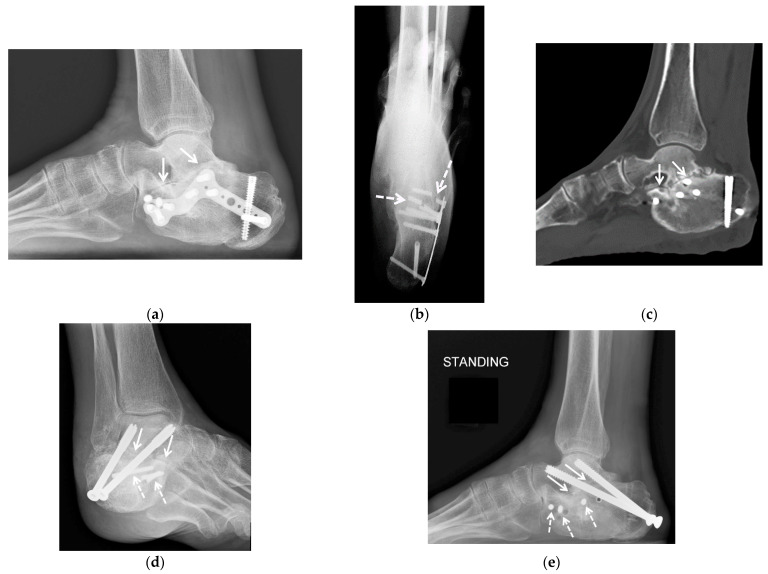
- Subtalar fusion (arthrodesis): the gold-standard surgery for advanced subtalar arthritis. The joint is permanently fused. Pain relief is usually excellent, but the foot loses side-to-side motion (you can no longer tilt the heel inward or outward).
- Triple arthrodesis: fusion of the subtalar, talonavicular, and calcaneocuboid joints together, used when arthritis affects multiple hindfoot joints
- Recovery: typically 8–12 weeks non-weight-bearing or in a boot, followed by gradual return to walking. Full recovery 6–12 months
- Joint preservation surgery is generally not as durable as fusion for established arthritis
Patients consistently report satisfaction with subtalar fusion when properly indicated, the trade-off of lost motion is usually outweighed by the relief of constant pain.
Bottom line
Subtalar arthritis is overwhelmingly a post-traumatic condition. If you’ve had a calcaneal or talar fracture, expect some degree of subtalar arthritis to develop. Conservative care can keep most patients functional for years; when surgery is needed, subtalar fusion is reliable and well-tolerated. The diagnosis is often delayed because the pain is mistaken for an ankle problem, getting it pinned down early opens up more options.
Sources
Last updated: July 16, 2026

About the author
Written and reviewed by a Doctor of Podiatric Medicine (DPM) practicing in Arizona for 6+ years. Board-certified by the American Board of Podiatric Medicine (ABPM); graduate of Midwestern University Arizona College of Podiatric Medicine.
Last clinically reviewed: July 16, 2026