
Quick answer
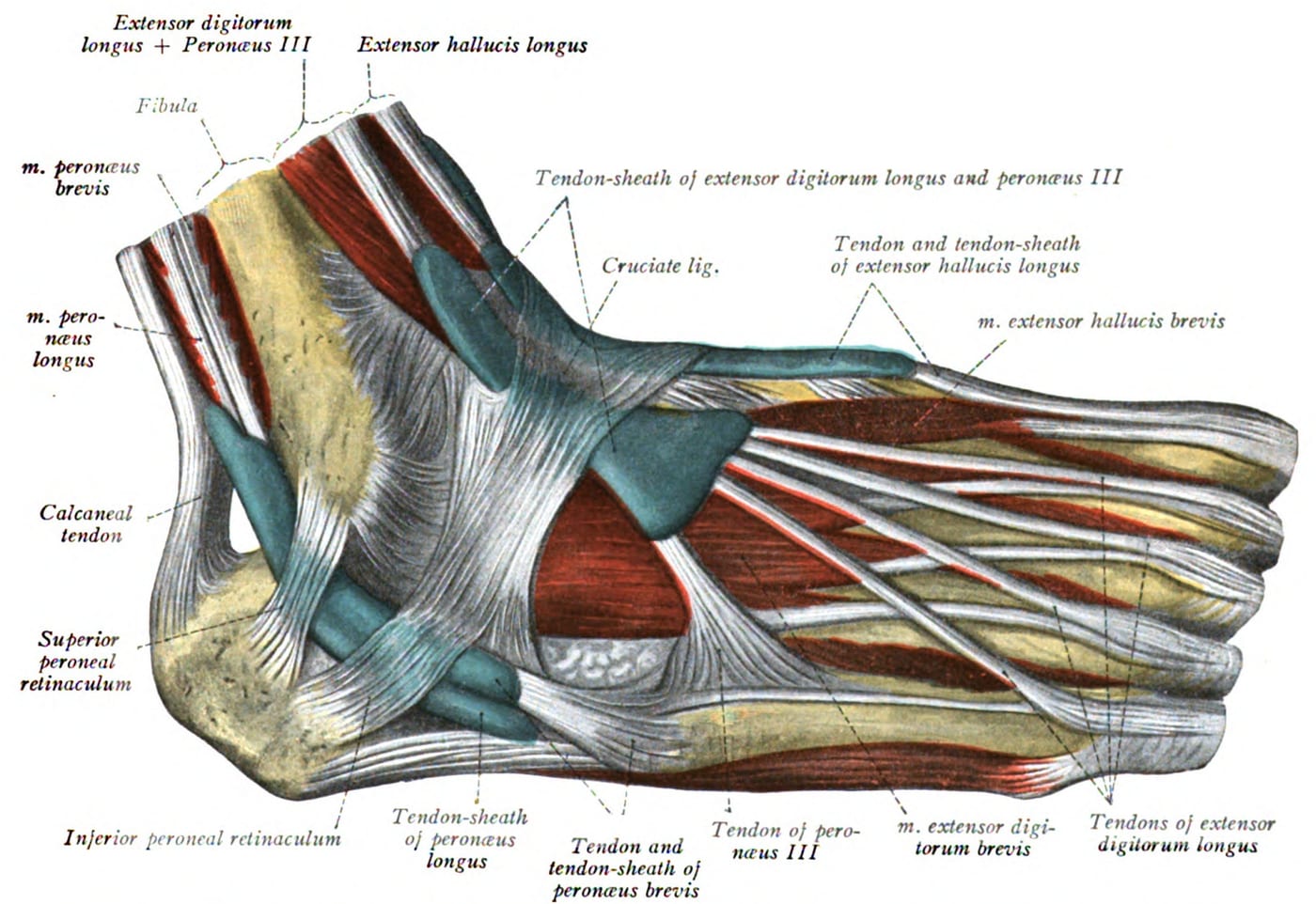
The peroneal tendons sit in a shallow groove on the back of the lateral malleolus (outside ankle bone), held in place by a band of tissue called the superior peroneal retinaculum. When this retinaculum tears or stretches, the tendons can slip forward over the bone during ankle motion, a sensation of snapping or popping that’s often visible. This is peroneal subluxation. It’s a distinct injury, separate from a regular sprain, and frequently recurs without treatment.
How it happens
The classic mechanism is forced dorsiflexion with sudden peroneal contraction: for example, a skier whose ski catches the snow as they shift weight, or a football player blocked from the side. The retinaculum tears and the tendons no longer stay seated.
Risk factors include:
- Shallow peroneal groove: some people are anatomically predisposed
- Generalized ligament laxity
- Prior ankle sprains (the retinaculum often gets stressed too)
- Activities with rapid foot positional changes: skiing, skating, soccer, dance
How to recognize it
- Visible or audible snapping behind the lateral ankle bone with foot motion
- A feeling of “rolling” or “clicking” with each step or with circumduction of the foot
- Discomfort or sharp pain along the lateral ankle, often with each subluxation event
- Sense of weakness or instability with eversion
- Often a history of an ankle sprain that didn’t fully resolve, patients sometimes describe it as “I rolled my ankle and it’s never been the same”
On exam, the tendons can sometimes be felt or seen to subluxate when the patient actively dorsiflexes and everts against resistance.
Diagnosis
- Physical exam: visualizing or palpating the subluxation is often diagnostic
- Ultrasound: dynamic, real-time imaging; the tendons can be seen slipping during motion
- MRI: shows the retinaculum tear, peroneal tendon condition, and any associated tears
- CT: sometimes used to assess the depth of the peroneal groove for surgical planning
Treatment
Acute injury (recently dislocated tendons)
- Rigid casting or a stirrup brace for 4–6 weeks with the foot held in slight inversion to allow the retinaculum to heal
- Outcomes are mixed, many patients still develop recurrent subluxation despite immobilization
Chronic / recurrent subluxation
When the tendons keep slipping despite conservative care, surgery is the standard treatment. Options include:
- Retinaculum repair: direct repair of the torn retinaculum
- Groove deepening: the peroneal groove is deepened in the back of the fibula so the tendons sit more securely
- Tissue transfer: sometimes a small piece of bone is rotated to deepen the groove (Du Vries procedure)
- Repair of associated tendon tears: many subluxations come with longitudinal splits in the brevis
- Recovery: 6–8 weeks immobilization, then progressive return to weight-bearing and rehab over 3–4 months
- Return to sport typically 4–6 months postoperatively
Outcomes are generally excellent, the recurrence rate after well-performed surgery is low.
Why it shouldn’t be ignored
- Recurrent subluxation is the most common consequence
- Peroneal tendon tears develop over time as the tendons rub against the fibular edge
- Chronic lateral ankle instability is common because the underlying biomechanics are altered
- Persistent dysfunction in athletic activity even between events
Patients sometimes live with snapping for years and then present with severe peroneal tendon tears, the tendons take damage with each subluxation.
Bottom line
Peroneal subluxation is a specific, identifiable injury, not “just a chronic sprain.” If you can see or hear the tendons snapping over the lateral malleolus, that’s the diagnosis. Acute injuries can be treated conservatively with mixed results; recurrent subluxation needs surgery, and modern surgical techniques are highly effective. Don’t accept “live with it”, addressing it prevents secondary tendon damage.
Last updated: April 28, 2026

About the author
Written and reviewed by a Doctor of Podiatric Medicine (DPM) practicing in Arizona for 6+ years. Board-certified by the American Board of Podiatric Medicine (ABPM); graduate of Midwestern University Arizona College of Podiatric Medicine.
Last clinically reviewed: April 28, 2026