Quick answer
Lymphedema is chronic swelling caused by a backed-up lymphatic system, the network of vessels and nodes that returns fluid and proteins from your tissues back into the bloodstream. When the lymphatics can’t keep up (because they were damaged, removed, blocked, or never developed properly), protein-rich fluid accumulates in the limb. The result is swelling that starts in the foot and toes, feels firmer over time, doesn’t fully resolve with elevation, and progressively changes the texture and shape of the limb. Early-stage lymphedema is highly treatable; late-stage disease is harder to reverse, which is why prompt diagnosis matters.
How to recognize it: and how it differs from other leg swelling
Several conditions can cause leg swelling. The pattern of swelling is the most useful diagnostic clue:
| Venous insufficiency | Lymphedema | Cardiac / kidney / liver edema | |
|---|---|---|---|
| Where it starts | Around the ankle, both legs | Foot and toes, often one leg | Both legs, equally, plus often whole body |
| Skin | Brown discoloration, itchy/eczema-like, varicose veins | Initially soft and pitting; later firm, “non-pitting,” thickened, sometimes pebbly | Soft, pitting; rarely chronic skin changes |
| Improves with overnight elevation? | Yes, usually | Partially in early stages, less and less over time | Yes |
| Stemmer sign (can’t pinch a fold of skin at the base of the second toe) | Negative | Positive, a hallmark of lymphedema | Negative |
| Recurrent skin infections (cellulitis)? | Possible if ulcerated | Common, a major complication | Uncommon |
Stemmer’s sign: the bedside test
A clinician will try to pinch and lift a fold of skin at the base of the second toe. In a normal foot or in venous edema, you can lift the skin easily. In lymphedema, the skin is too thickened and adherent, you can’t pinch a fold. A positive Stemmer’s sign is highly specific for lymphedema and is one of the most useful single physical findings.
Stages: the International Society of Lymphology (ISL) system
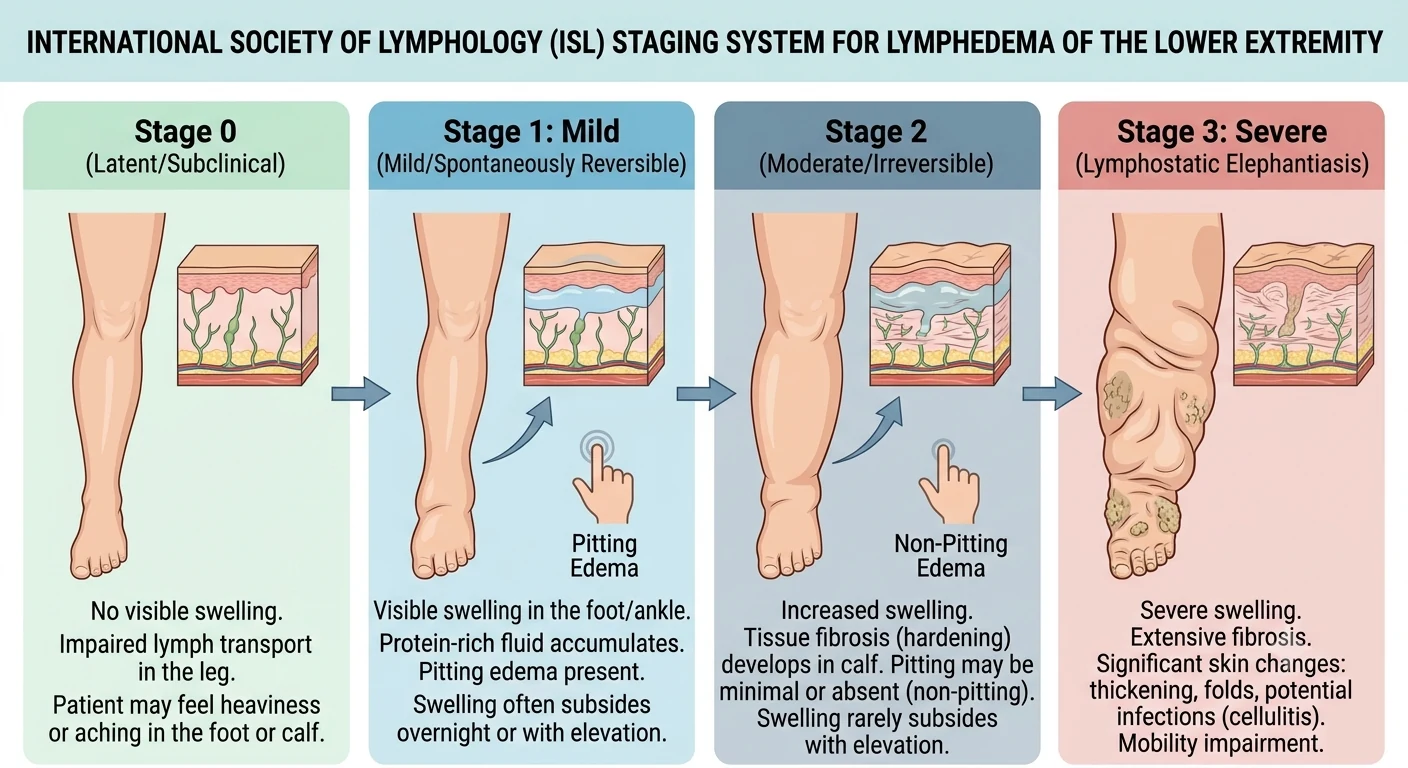
Lymphedema is staged 0 through III based on tissue changes:
- Stage 0 (latent / subclinical): the lymphatic system is impaired but no visible swelling. Patient may report a heavy or full feeling. Important to recognize because early intervention here can prevent progression.
- Stage I (reversible): soft pitting edema that improves with elevation overnight. No skin changes yet.
- Stage II (spontaneously irreversible): swelling no longer fully resolves with elevation. Tissue starts to fibrose; pitting becomes harder to demonstrate. Stemmer’s sign becomes positive.
- Stage III (lymphostatic elephantiasis): severe, hardened, sometimes pebbly or warty skin changes; recurrent infections; major limb deformity; no pitting
The earlier the stage at the start of treatment, the better the outcome.
Reuse this image for free
Free to use on your own site, blog, or patient handout. Please keep a visible credit link back to MyHealthyFeet.
<a href="https://myhealthyfeet.org/conditions/lymphedema/"><img src="https://myhealthyfeet.org/images/conditions/lymphedema-stages.webp" alt="ISL staging of lower-limb lymphedema, stages 0 to 3" width="1408" height="768" /></a>
<p>Illustration: <a href="https://myhealthyfeet.org/conditions/lymphedema/">MyHealthyFeet</a></p>
Why it happens
Lymphedema is divided into two big categories:
Primary lymphedema (about 10% of cases)
A genetic or developmental abnormality in the lymphatic vessels themselves. Subtypes are categorized by age of onset:
- Congenital (Milroy disease), present at or shortly after birth
- Praecox: onset in adolescence or early adulthood (most common primary form)
- Tarda: onset after age 35
Secondary lymphedema (about 90% of cases)
Damage to a previously normal lymphatic system. Common causes:
- Cancer treatment: surgical removal of lymph nodes (e.g., pelvic, groin, or axillary node dissection) and radiation are the leading causes in developed countries. Foot/leg lymphedema can follow gynecologic, urologic, melanoma, or other pelvic cancer treatments.
- Filariasis (lymphatic filariasis), a parasitic infection by Wuchereria bancrofti and related worms; the world’s leading cause of lymphedema, almost exclusively in tropical and subtropical regions
- Recurrent cellulitis: repeated skin infections damage the lymphatics over time, creating a vicious cycle (lymphedema → infection → more lymphedema)
- Trauma or surgery to a limb
- Long-standing chronic venous insufficiency: produces a mixed venous/lymphatic edema (sometimes called phlebolymphedema)
- Obesity: severe obesity can cause secondary lymphatic obstruction (obesity-induced lymphedema)
- Tuberculosis and other chronic infections of lymph nodes
How a clinician makes the diagnosis
Most lymphedema is diagnosed clinically: based on the history, the pattern of swelling (foot and toes involved, asymmetric, progressive), the Stemmer’s sign, and the limb texture. Imaging is reserved for unclear cases or surgical planning:
- Lymphoscintigraphy: the gold-standard imaging test. A radioactive tracer is injected between the toes, and a camera tracks how it travels through the lymphatic system. Shows where the system is failing.
- Indocyanine green (ICG) lymphography: newer near-infrared imaging; useful for detailed lymphatic mapping and surgical planning
- MRI / CT: to rule out a tumor or mass obstructing the lymphatics, especially in unilateral or unusual cases
- Duplex ultrasound: to rule out concurrent venous disease or DVT
- Bioimpedance spectroscopy: measures extracellular fluid and is increasingly used to detect Stage 0 disease before swelling becomes visible
Treatment
The cornerstone of lymphedema treatment is Complete Decongestive Therapy (CDT): a multi-component approach that works very well when started early and applied consistently.
Safety first: compression and circulation. Do not start compression garments, bandaging, or a pump if you have peripheral arterial disease (PAD) or poor circulation without a doctor’s clearance. Compression on a limb that is already short on arterial blood flow can reduce it further and damage tissue. If you have PAD, diabetes, or cold, pale, or discolored feet, ask for an ankle-brachial index (ABI) check before compression is started.
Complete Decongestive Therapy (CDT): the standard of care
CDT is delivered in two phases by a certified lymphedema therapist (often a physical or occupational therapist with specialized training):
Phase 1, Intensive / reductive phase (typically 2–6 weeks of daily or near-daily treatment):
- Manual lymphatic drainage (MLD): a specific gentle massage technique that moves lymph fluid from the swollen limb toward areas where the lymphatics are still working
- Multilayer short-stretch compression bandaging: applied daily after MLD; far more reductive than off-the-shelf stockings during this phase
- Decongestive exercises: specific movements done while bandaged to use muscle pumping to help move lymph
- Meticulous skin care: moisturizing, treating any cracks immediately, preventing the cellulitis that can rapidly worsen lymphedema
- Patient education on long-term self-management
Phase 2, Maintenance / self-management phase (lifelong):
- Daytime compression garments: custom-fitted flat-knit stockings (different from venous compression stockings, flat knit holds shape better against the firmer lymphedematous tissue). Typical compression class 20–40 mmHg or higher depending on severity.
- Nighttime compression: short-stretch bandages, foam-and-fabric devices, or specialty nighttime garments for moderate-to-severe disease
- Self-MLD taught during Phase 1
- Continued exercise: walking, swimming (excellent for lymphedema), yoga, strength training
- Skin care as a daily habit
- Weight management if applicable
CDT, applied consistently, dramatically reduces limb volume and prevents progression. Recent systematic reviews continue to support it as the standard intervention. Outcomes are best when treatment starts in Stage I or earlier; advanced (Stage III) cases benefit but rarely return to normal limb size.
Adjuncts to CDT
- Pneumatic compression pumps: sequential gradient pumps used at home to supplement compression garments; helpful for some patients, less effective than full CDT alone
- Low-level laser therapy: modest evidence; sometimes used by therapists
- Nutrition: adequate protein intake is important; low-sodium diet helps; some patients try MCT-based diets for chylous reflux variants
Cellulitis prevention and prompt treatment
People with lymphedema are at dramatically increased risk of cellulitis, and each episode worsens the underlying lymphatic damage. Strategies:
- Treat any skin break immediately: even a small cut or athlete’s foot
- Daily skin inspection and moisturizing
- Treat athlete’s foot and toenail fungus aggressively: fungal infections are a major entry point for cellulitis in this population
- Prophylactic antibiotics for patients with frequent recurrences (penicillin V or similar, on a clinician’s recommendation)
- Recognize early signs of cellulitis: sudden redness, warmth, increasing swelling, fever, and seek same-day care
Surgical and advanced procedural options
For carefully selected patients who don’t respond adequately to CDT, several surgical options exist. These are typically performed at specialized lymphedema centers by reconstructive microsurgeons:
- Lymphovenous bypass (lymphovenous anastomosis, LVA): supermicrosurgery to connect tiny lymphatic vessels to nearby small veins, creating a bypass around blocked areas. Best for early-stage disease where the lymphatics are still functional but blocked. Outpatient or short-stay procedure.
- Vascularized lymph node transfer (VLNT): transplanting healthy lymph nodes from another part of the body into the affected limb. Used for moderate disease where bypass alone isn’t enough.
- Suction-assisted lipectomy (lymphedema-specific liposuction): for late-stage disease where the swelling is dominated by chronic fibrofatty tissue rather than fluid (these don’t respond to CDT alone). Usually combined with continued lifelong compression.
- Excisional procedures (Charles, Sistrunk, Homans), older debulking surgeries for severe Stage III cases; used much less today
The decision to pursue surgery is highly individualized and depends on stage, the quality of the remaining lymphatics on imaging, body habitus, and patient goals. Surgery is an addition to CDT, not a replacement: even after surgery, lifelong compression is usually still needed.
When to see a clinician
Get evaluated for:
- Persistent or worsening leg swelling, particularly when the foot and toes are involved
- Swelling that doesn’t fully resolve overnight with elevation
- Skin changes, thickening, firmness, or pebbly texture
- Any history of pelvic/abdominal cancer surgery or radiation followed by leg swelling
- Recurrent leg cellulitis episodes
- A heavy, full feeling in a limb after cancer treatment, even without obvious swelling (early/Stage 0 disease)
Same-day evaluation for:
- Sudden redness, warmth, or rapidly spreading skin change in a swollen limb (cellulitis)
- Fever and chills with limb swelling
- Sudden one-sided swelling with calf pain (rule out DVT)
Bottom line
Lymphedema is fundamentally different from other forms of leg swelling; it involves the foot and toes, gets firmer over time, doesn’t fully resolve with elevation, and dramatically raises the risk of recurrent cellulitis. The Stemmer’s sign at the base of the second toe is one of the most useful single physical findings. Complete Decongestive Therapy by a certified lymphedema therapist is the standard of care and works very well when started early: Stage I and II lymphedema can often be controlled long-term with no further procedures. Advanced cases benefit from a coordinated approach combining CDT with surgical options at specialized centers. The single most important shift is getting the right diagnosis early: too many patients spend years being told they have “just venous swelling” or “just water retention” before lymphedema is named and properly treated. This page is general educational information; the diagnosis and treatment plan need to come from a clinician familiar with lymphedema, ideally a certified lymphedema therapist working with a vascular or lymphatic specialist.
Sources
- International Society of Lymphology. The diagnosis and treatment of peripheral lymphedema: 2020 Consensus Document ↗
- Davis E et al. Complete decongestive therapy phase 1: an expert consensus document (2024) ↗
- Mehrara B. Effectiveness of complete decongestive therapy for upper extremity breast cancer-related lymphedema: a review of systematic reviews (2024) ↗
- Sleigh BC, Manna B. Lymphedema. StatPearls (updated 2023) ↗
- Goss JA, Greene AK. Sensitivity and Specificity of the Stemmer Sign for Lymphedema: A Clinical Lymphoscintigraphic Study. Plast Reconstr Surg Glob Open (2019) ↗
Last updated: May 1, 2026

About the author
Written and reviewed by a Doctor of Podiatric Medicine (DPM) practicing in Arizona for 6+ years. Board-certified by the American Board of Podiatric Medicine (ABPM); graduate of Midwestern University Arizona College of Podiatric Medicine.
Last clinically reviewed: May 1, 2026