Quick answer
Chronic venous insufficiency (CVI) is what happens when the one-way valves inside your leg veins stop closing properly. Normally those valves push blood back up against gravity toward the heart. When they fail, blood pools in the lower legs, and the pooling causes the symptoms: swelling, heaviness, achy legs at the end of the day, varicose veins, brownish skin changes around the ankles, and in advanced cases, chronic, slow-healing ulcers just above the inner ankle. CVI is very common, gradually progressive, and highly treatable: but the earlier it’s addressed, the easier it is to prevent the late-stage skin and wound complications.
Important, distinguish CVI from a DVT. A gradual, both-leg, end-of-the-day swelling that improves with elevation overnight is usually CVI. A sudden, painful, one-sided swelling, especially with redness, warmth, or shortness of breath, is a possible deep vein thrombosis (DVT): a clot in a leg vein that can travel to the lungs (pulmonary embolism). DVT is a vascular emergency. If symptoms came on quickly and feel different from your usual leg swelling, go to an emergency department rather than waiting for a clinic appointment.
How to recognize it
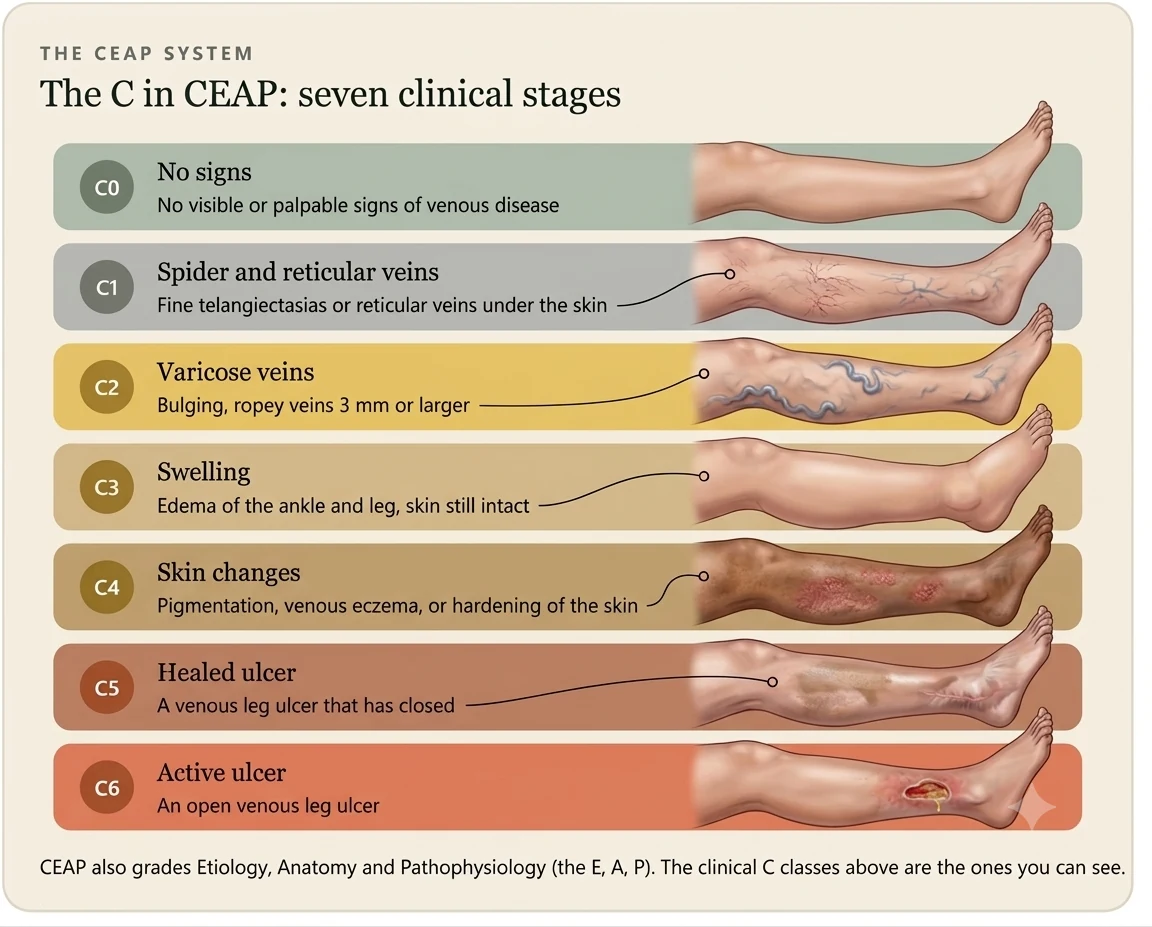
CVI usually develops slowly and goes through recognizable stages. The international CEAP classification describes these by clinical appearance:
- C0, No visible signs, but symptoms (heaviness, aching, fatigue) may already be present
- C1, Telangiectasias and reticular veins (“spider veins”), small surface veins, mostly cosmetic
- C2, Varicose veins: bulging, twisted surface veins ≥3 mm
- C3, Edema: visible leg swelling, especially around the ankle, worse at the end of the day
- C4, Skin changes: brown discoloration (hemosiderin staining), eczema-like rash (stasis dermatitis), thickened/woody skin (lipodermatosclerosis), or white scars (atrophie blanche)
- C5, Healed venous ulcer
- C6, Active venous ulcer, classically just above the inner (medial) ankle
Reuse this image for free
Free to use on your own site, blog, or patient handout. Please keep a visible credit link back to MyHealthyFeet.
<a href="https://myhealthyfeet.org/conditions/chronic-venous-insufficiency/"><img src="https://myhealthyfeet.org/images/conditions/ceap-classification.webp" alt="CEAP classification of chronic venous disease, stages C0 to C6" width="1152" height="927" /></a>
<p>Illustration: <a href="https://myhealthyfeet.org/conditions/chronic-venous-insufficiency/">MyHealthyFeet</a></p>
The most common day-to-day symptoms patients describe:
- Leg heaviness or aching that’s worse later in the day, after standing
- Swelling around the ankles that improves overnight after elevation
- Itchy or burning skin on the lower legs
- Visible varicose veins
- Brown discoloration above the ankle that started subtly and got darker over years
- Restless legs at night, leg cramps, or a “tired legs” feeling
Why it happens
The valves in your leg veins fail when:
- Prior deep vein thrombosis (DVT) has damaged the valves directly (post-thrombotic syndrome)
- Chronic venous hypertension stretches the vein walls and pulls the valve leaflets apart over years
- Pregnancy dramatically increases venous pressure and is a major contributor in women
- Genetics: varicose veins and CVI run strongly in families
- Occupations involving prolonged standing (teachers, nurses, hairdressers, factory workers, surgeons)
- Obesity increases intra-abdominal pressure that backs up into the leg veins
- Age: collagen and valve function decline over time
Once a few valves fail, the column of blood above them puts more pressure on the next valves down, and the failure progresses upward. This is why CVI gets worse if untreated.
How a clinician makes the diagnosis
Diagnosis is largely clinical but is confirmed and quantified with imaging:
- Physical exam: inspection for varicose veins, edema, skin changes; checking pulses and ankle range of motion
- Venous duplex ultrasound: the gold standard test. A non-invasive ultrasound that maps which veins have reflux (incompetent valves) and how long the reflux lasts. Required before any procedural treatment.
- Ankle-brachial index (ABI): done before any compression therapy is started, to confirm there isn’t significant arterial disease (compression on a leg with poor arterial supply can cause damage)
- Other tests in select cases: venography, MR venography, CT venography, used mainly for complex anatomy or pelvic vein involvement
Treatment
CVI treatment is staged based on severity. Conservative care is the foundation for everyone; procedures address specific failed veins.
Conservative care (first-line for everyone with CVI)
These reduce symptoms and slow progression. Compression is the cornerstone.
- Graduated compression stockings: the single most important treatment. Knee-high, 20–30 mmHg is a typical starting strength for symptomatic CVI; 30–40 mmHg for advanced disease, ulcers, or post-DVT cases. Worn during the day, removed at night. Get an ABI checked first if you have any signs of poor circulation.
- Leg elevation: feet above the heart for 15–30 minutes a few times a day, and during sleep
- Calf-pump exercise: walking, ankle pumps, calf raises. The calf muscle is the “second heart” that pumps blood back up the legs.
- Weight optimization: even modest weight loss meaningfully reduces venous pressure
- Skin care: daily moisturizer; treat eczema-like changes (stasis dermatitis) early with bland emollients ± a short course of topical steroid prescribed by your clinician. Do not scratch: broken skin in this setting heals very slowly and is the entry point for most venous ulcers.
- Avoid prolonged standing or sitting without movement; flex the calves periodically
For most patients with C2–C4 disease, compression + exercise + elevation controls symptoms indefinitely without needing any procedure.
Procedures for specific incompetent veins
When duplex ultrasound shows a clearly refluxing vein driving the symptoms, modern minimally-invasive endovenous procedures have largely replaced traditional open vein surgery:
- Endovenous thermal ablation: radiofrequency (RFA) or laser (EVLA) energy delivered through a catheter inside the diseased vein, sealing it shut. Outpatient, local anesthesia, return to walking the same day. Current first-line procedural treatment for great or small saphenous vein reflux.
- Cyanoacrylate glue closure (VenaSeal): a medical-grade adhesive that seals the vein. No tumescent anesthesia required, no compression stocking afterward in some protocols. Increasingly used as an alternative to thermal ablation.
- Mechanochemical ablation (MOCA / ClariVein): combines mechanical disruption of the vein wall with a sclerosant; non-thermal alternative
- Ultrasound-guided foam sclerotherapy: used for tributary varicose veins, recurrent veins, or as an alternative when ablation isn’t ideal
- Microphlebectomy / ambulatory phlebectomy: small incisions to remove visible bulging varicose veins, often done at the same visit as ablation
- Liquid sclerotherapy: for spider veins (C1), cosmetic
- High ligation and stripping: older surgical technique, largely replaced by endovenous methods but still occasionally used for specific anatomy
Venous ulcer care (C6)
Healing a chronic venous ulcer requires all of:
- Multilayer compression bandaging (e.g., Profore, Coban-2, Unna boot), applied weekly by a wound care clinician until the ulcer heals
- Aggressive wound care: debridement of nonviable tissue, appropriate dressings
- Treatment of the underlying venous reflux with one of the procedures above, without addressing the source, ulcers recur
- Long-term lifelong compression stockings after healing to prevent recurrence
- Skin grafting in select large, recalcitrant ulcers
Adjuncts and newer options
- Venoactive medications (micronized purified flavonoid fraction / MPFF, horse chestnut extract), modest symptom relief; widely used in Europe, less commonly prescribed in the US
- Pneumatic compression devices: for severe edema, after-hours adjunct to stockings
- Pelvic vein evaluation: for atypical varicose vein patterns, especially in women with pelvic pain, refluxing pelvic veins (pelvic venous insufficiency / “pelvic congestion syndrome”) may need separate treatment
When to see a clinician
Make an appointment for:
- Persistent leg swelling, heaviness, or aching at the end of the day
- Visible varicose veins that ache, throb, or feel hot
- Brown skin discoloration, itchy/eczema-like rash, or thickening above the ankle
- Any non-healing wound on the lower leg or ankle
- Restless legs at night that disrupt sleep
Same-day evaluation for any of:
- Sudden swelling of one leg, especially with calf pain, warmth, or redness, possible DVT
- Shortness of breath, chest pain, or coughing up blood, possible pulmonary embolism (call 911)
- A leg ulcer that’s rapidly enlarging, has signs of infection (fever, surrounding redness, pus), or is in someone with diabetes or immune suppression
Bottom line
CVI is one of the most common and most under-treated vascular conditions. Compression stockings are the single highest-impact intervention and prevent the gradual march from mild swelling to chronic ulcers. When a specific refluxing vein is driving the symptoms, modern outpatient endovenous procedures (thermal ablation, glue, sclerotherapy) are highly effective with minimal downtime. Catch CVI in the swelling-and-aching stage, and you usually never see the skin changes or ulcers; ignore it for years and the late-stage complications are much harder to reverse. This page is general educational information; the diagnosis, the duplex ultrasound interpretation, and the treatment plan need to come from a vascular specialist or vein-trained clinician.
Sources
- Lurie F et al. The 2020 update of the CEAP classification system and reporting standards. J Vasc Surg Venous Lymphat Disord (2020) ↗
- Patel SK, Surowiec SM. Venous Insufficiency. StatPearls (updated 2023) ↗
- ESVS 2022 Clinical Practice Guidelines on the Management of Chronic Venous Disease ↗
- Eberhardt RT, Raffetto JD. Chronic Venous Insufficiency. Circulation (2014; periodically updated) ↗
Last updated: May 1, 2026

About the author
Written and reviewed by a Doctor of Podiatric Medicine (DPM) practicing in Arizona for 6+ years. Board-certified by the American Board of Podiatric Medicine (ABPM); graduate of Midwestern University Arizona College of Podiatric Medicine.
Last clinically reviewed: May 1, 2026