Quick answer
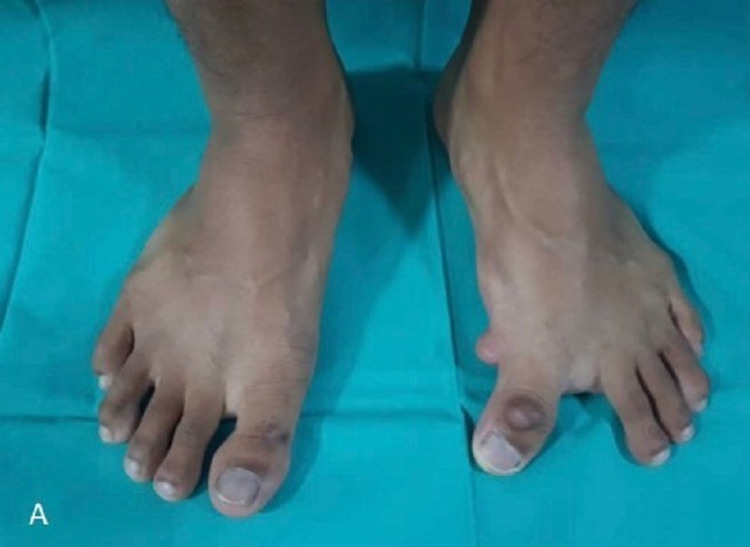
A bunion (hallux valgus) is when the big toe drifts toward the second toe. Hallux varus is the opposite, the big toe drifts away from the second toe, toward the inside of the foot. The most common cause is overcorrection during bunion surgery, where the muscle and ligament rebalancing pulls the toe too far in the other direction. Less commonly, it’s congenital, post-traumatic, or part of rheumatoid arthritis.
Why it develops
Post-surgical (most common)
Modern bunion correction involves rebalancing soft tissue (releasing tight structures on the lateral side, tightening the medial side) along with bony work. Several specific scenarios can lead to hallux varus:
- Excessive lateral release or excision of the fibular sesamoid
- Overaggressive medial capsular tightening
- Overcorrection of the intermetatarsal angle
- Removal of too much bone from the metatarsal head
It typically becomes apparent within weeks to months after surgery.
Other causes
- Congenital hallux varus: present at birth, sometimes associated with other forefoot anomalies
- Trauma: particularly avulsion injuries to the lateral structures
- Rheumatoid arthritis: late-stage erosive disease can deviate the toe medially
- Spasticity in neurological conditions
How to recognize it
- Big toe pointed toward the inside (medial side) of the foot
- Visible gap between the big toe and the second toe
- Difficulty fitting shoes: the medial deviation often presses against the shoe edge
- Stiffness of the big toe joint, sometimes progressing to fixed deformity
- Pain on the medial side of the joint
- Cocking up of the big toe (extension contracture) in some cases, a related deformity
- Loss of push-off strength when pronounced
Diagnosis
- Visual exam: the deformity is usually obvious
- Assess flexibility: flexible deformities can sometimes be passively corrected; rigid ones cannot
- Weight-bearing X-rays: measure the hallux varus angle, assess the joint surfaces, and identify any prior surgical changes
- History: bunion surgery, trauma, or congenital onset
Treatment
Mild and flexible
- Wide toe-box shoes to accommodate the deformity
- Toe spacers: placed in the shoe to nudge the big toe back toward neutral (limited effectiveness)
- Buddy taping: pulls the big toe toward the second toe for cosmetic and supportive effect
- Padding to reduce friction with shoes
- NSAIDs for joint pain when needed
Conservative care manages symptoms but doesn’t correct the underlying alignment.
Surgery
The right surgical technique depends on the cause, the flexibility, and the condition of the joint.
For flexible deformities with a healthy joint:
- Soft-tissue rebalancing: release of tight medial structures, transfer or augmentation on the lateral side
- Tendon transfer: most commonly the abductor hallucis or extensor hallucis brevis is rerouted to pull the toe laterally
For rigid deformities or arthritic joints:
- 1st MTP joint fusion (arthrodesis): fuses the joint in proper alignment; reliable for pain relief, especially when the joint is arthritic
- Joint replacement: selectively, in non-active patients
Recovery typically involves 4–8 weeks in a post-op shoe or boot, with full recovery 3–6 months.
Bottom line
Hallux varus is the mirror image of a bunion and most often a post-surgical issue. Mild flexible cases can be managed with shoes and padding; rigid or progressive cases are best corrected surgically, with technique selection based on joint condition. The best treatment is prevention: avoiding overcorrection during the original bunion surgery, but when it does develop, modern reconstructive techniques restore good alignment and function.
Sources
Last updated: July 16, 2026

About the author
Written and reviewed by a Doctor of Podiatric Medicine (DPM) practicing in Arizona for 6+ years. Board-certified by the American Board of Podiatric Medicine (ABPM); graduate of Midwestern University Arizona College of Podiatric Medicine.
Last clinically reviewed: July 16, 2026