
Quick answer
Brachydactyly is a congenital condition in which one or more toes are shorter than usual, due to underdeveloped or fused bones in the affected digit. The most common foot pattern is a shortened fourth toe (often actually brachymetatarsia: a short metatarsal rather than a short toe itself). For most people it’s a cosmetic difference; some experience shoe-fit issues or pressure on neighboring toes.
Brachydactyly vs. brachymetatarsia
These terms are often used interchangeably but mean different things anatomically:
- Brachydactyly: short toe due to short or fused phalanges (the small bones in the toe itself)
- Brachymetatarsia: short toe due to a short metatarsal (the long bone in the foot leading to that toe)
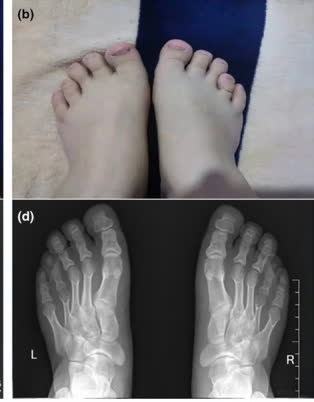
Brachymetatarsia is what’s usually meant when people speak of a “short fourth toe”, the metatarsal stops growing prematurely, and the toe sits noticeably higher and shorter than its neighbors.
How to recognize it
- A toe that’s noticeably shorter than the others
- The shortened toe sits higher: often riding above its neighbors as they “fill the gap”
- Often bilateral: both feet affected, especially in inherited cases
- The fourth toe is most common, but any toe can be affected
- Normal toe function in many cases, the deformity is mostly cosmetic
- Sometimes pressure-related symptoms:
- Pressure on the shortened toe from shoes (since it sits higher)
- Increased pressure on adjacent toes that take more load
- Calluses under metatarsal heads adjacent to the short one
Why this happens
In brachymetatarsia, the growth plate of the affected metatarsal closes early, stopping bone growth before the metatarsal reaches its full length. The bone is structurally normal, just shorter than it should be.
Causes include:
- Inherited: autosomal dominant in many families. Look for family members with the same pattern.
- Idiopathic: no clear cause identified
- Associated with syndromes: Albright hereditary osteodystrophy, Turner syndrome, Down syndrome, and others (uncommon)
- Acquired: after childhood trauma to a growth plate, infection, or chemotherapy in childhood
The shortening usually becomes obvious between ages 4 and 12, as the surrounding bones grow and the shortened metatarsal doesn’t keep up.
Diagnosis
- Physical exam: the visual difference is usually obvious
- X-rays: confirm which bones are short, measure the discrepancy, and assess growth plates
- Family history: often clarifies the diagnosis
- Genetic evaluation: when associated features suggest a syndrome (uncommon)
Treatment
Conservative care
For most patients, brachydactyly is manageable without surgery:
- Shoe modification: wider toe boxes, soft uppers
- Padding: silicone toe sleeves cushion the high-riding short toe from shoe pressure
- Toe spacers or fillers: fill the gap and protect adjacent toes
- Custom orthotics: redistribute load when calluses form under adjacent metatarsals
- Reassurance: many patients are happy with conservative measures once the foot is supported
Surgery
Surgical lengthening is offered for:
- Significant cosmetic concerns: sometimes the most common reason
- Pain from shoe pressure that doesn’t respond to conservative care
- Functional problems with the metatarsal arch and load distribution
- Patient preference after a thorough discussion of risks and recovery
There are two main surgical approaches:
Acute (one-stage) lengthening
- Bone is cut, separated, and a bone graft is inserted to fill the gap
- Internal hardware (plate or wires) holds the lengthened bone
- Faster recovery: single surgery, no external apparatus
- Limited lengthening: can typically only add 10–15 mm safely
- Recovery typically 8–12 weeks
Gradual (callotasis / external fixator)
- Bone is cut, then slowly distracted by a small external frame turned daily by the patient
- New bone forms in the gap as the bone is gradually pulled apart
- Can achieve greater lengthening (15–20 mm or more)
- Process takes months: typically 3–6 months in the fixator, plus consolidation time
- More demanding for the patient but allows greater correction
The surgical decision is highly individual and should only be made after a thorough in-person consultation with a foot and ankle surgeon, including a frank conversation about expected gain, recovery time, and the real risks listed below.
What surgery realistically accomplishes: and what it doesn’t
Surgical lengthening of a short metatarsal is technically demanding, has a meaningful complication rate, and often produces a result that is improved but not “normal.” Patients considering this surgery should have realistic expectations.
What surgery may achieve in well-selected patients:
- Partial lengthening of the affected toe, typically 10–15 mm with one-stage techniques, sometimes 15–25 mm with gradual distraction. The lengthened toe is usually still shorter than the adjacent toes; the goal is improvement, not symmetry.
- Better shoe fit for some patients
- Reduced pressure on adjacent toes when load redistribution was a problem
- Improved cosmetic appearance within the limits of how much length the soft tissue, blood supply, and nerves will safely tolerate
What surgery often does not achieve:
- A toe that matches the others in length or appearance
- Full correction of any associated hammertoe, arthritis, or joint stiffness
- Elimination of the need for thoughtful footwear: wider shoes are often still recommended afterward
- Quick recovery: particularly with the gradual / external-fixator approach, which keeps the patient in a frame for months
Risks and complications of surgical lengthening
Both one-stage and gradual lengthening procedures carry real risks. In published series the overall complication rate ranges from roughly 20% to 50% depending on the technique, the amount of lengthening attempted, and the surgeon’s experience. Specific risks include:
- Neurovascular injury: the small nerves and arteries supplying the toe can be stretched, kinked, or cut during lengthening. This can cause numbness, persistent pain, or, in severe cases, vascular compromise of the toe and toe necrosis (loss of the toe).
- Stiffness and reduced motion at the metatarsophalangeal (MTP) joint, common (reported in 30–50% of cases in some series); some patients trade a short toe for a stiff toe
- Non-union or delayed union: the bone fails to heal in the lengthened position, sometimes requiring revision surgery
- Pin-tract infection with external fixator techniques, common (up to ~25–50% in some series); usually superficial but occasionally deep and serious
- Pin loosening, breakage, or premature removal: may require revision
- Floating toe: the lengthened toe no longer touches the ground, losing function
- Less length gained than expected, or paradoxical shortening if the bone resorbs
- Adjacent-toe deformity: neighboring toes can develop new problems as load redistributes
- Hardware complications: plate/screw irritation, breakage, or removal surgery
- Persistent pain, even after technically successful lengthening
- Wound healing problems and scarring
- Need for additional surgery to address complications or refine the result
- Cosmetic dissatisfaction: even after successful lengthening, some patients are not happy with the appearance
- Anesthetic risks common to any surgery
These risks rise with the amount of lengthening attempted (longer = riskier), with gradual external-fixator techniques (more pin-related complications), and in patients with vascular disease, diabetes, smoking history, or prior foot surgery.
Bottom line
Brachydactyly and brachymetatarsia are most often inherited variations with normal foot function that need no treatment beyond well-fitting shoes. Conservative care, supportive footwear, padding, toe spacers, and orthotics, addresses symptoms in the majority of cases without risk.
Surgical lengthening exists, can produce real improvements in selected patients, and is not a minor procedure. It carries meaningful risks including stiffness, infection, neurovascular injury, non-union, and, rarely, vascular compromise that can cost the toe. Reported complication rates of 20–50% mean roughly a quarter to half of patients experience some setback, even with experienced surgeons.
This page is general educational information and is not a substitute for an in-person evaluation. Anyone considering surgery for brachydactyly or brachymetatarsia should have an unhurried, in-person consultation with a board-certified foot and ankle surgeon (orthopedic or podiatric), ideally one who performs metatarsal lengthening regularly, and review their own X-rays, expected gain, recovery timeline, and the full list of risks before deciding. Cosmetic surgery on a toe is an elective trade-off; the decision should never be rushed and should never be based on a website.
Sources
Last updated: May 1, 2026

About the author
Written and reviewed by a Doctor of Podiatric Medicine (DPM) practicing in Arizona for 6+ years. Board-certified by the American Board of Podiatric Medicine (ABPM); graduate of Midwestern University Arizona College of Podiatric Medicine.
Last clinically reviewed: May 1, 2026