
What Stretches Actually Help Plantar Fasciitis?
The 4-stretch routine I give plantar fasciitis patients: the fascia stretch before your first steps, both calf stretches, and the frozen bottle roll, plus the barefoot rule that protects your progress.
July 19, 2026
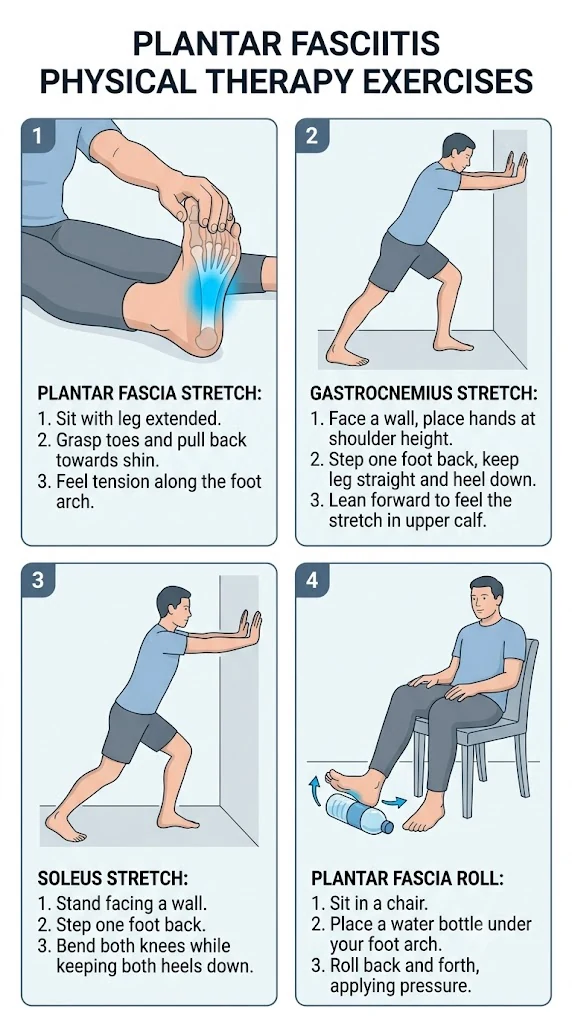
This is the question I hear more than any other in clinic, and the honest answer is that four stretches carry almost all of the weight. They are in the image above, numbered in the order I teach them.
The routine
- Plantar fascia stretch. Sit with the leg extended or crossed over your knee, grab your toes, and pull them back toward the shin until the arch tightens. Hold 30 seconds. This is the one that matters most, and it is the one with the best research behind it: a randomized trial found this fascia-specific stretch beat standard calf stretching alone.
- Calf stretch, straight knee. Hands on the wall, back leg straight, heel down, lean in. Hold 30 seconds. This targets the gastrocnemius, the big calf muscle that feeds tension into your heel.
- Calf stretch, bent knee. Same wall, both knees bent, heels down. Hold 30 seconds. Bending the knee shifts the stretch to the soleus, the deeper muscle underneath.
- Bottle roll. Sit and roll a water bottle under your arch for 1 to 2 minutes. Freeze the bottle first and you get icing and massage at the same time.
Run the whole set 2 to 3 times a day. Consistency beats intensity, every time.
The one detail almost everyone gets wrong: do stretch number 1 before your first steps of the day, while you are still sitting on the edge of the bed. The fascia tightens overnight, and those first cold steps are the re-injury. Stretching it before it takes your body weight is the highest-value 30 seconds in this whole routine. That is also why the pain is worst in the morning; the full explanation is on our plantar fasciitis page.
The barefoot rule
Stretching giveth, and barefoot walking taketh away. Walking barefoot on hard floors, even just around the house, keeps re-straining the fascia between your stretching sessions.
So: supportive shoes, all day, including at home. If regular shoes indoors feel wrong to you, use a supportive sandal or clog as a dedicated house shoe. Patients do well with Crocs (the classic clog, with the strap back), OOFOS recovery slides, and Birkenstocks with the cork footbed. I have no relationship with any of these companies; they are simply the categories my patients actually wear, and any house shoe with real arch support and a cushioned sole does the job. The point is the support, not the brand.
When stretching is not enough
Give the routine 4 to 6 honest weeks. If the heel pain has not clearly improved by then, or you have pain at night, at rest, numbness, or you have diabetes, get examined. There is a whole treatment ladder beyond stretching, and a few other conditions imitate plantar fasciitis well enough that they need different treatment. Start with the plantar fasciitis guide to see the full picture, and if you want this routine on paper for the fridge, there is a printable handout version too.
Frequently asked questions
When is the best time to do plantar fasciitis stretches?
Before your first steps of the day. The fascia tightens overnight, and those first cold steps re-strain it. Sit on the edge of the bed, pull your toes back toward your shin for 30 seconds, and only then stand up. Repeat the full routine 2 to 3 times through the day.
How long until stretching helps plantar fasciitis?
Most people notice meaningful improvement within 2 to 4 weeks of consistent daily stretching, and the research backs the fascia-specific stretch in particular. Think weeks, not days. If several weeks of honest daily consistency has not moved the pain, that is the signal to get examined.
Related guides
This is general educational information from a licensed podiatrist, not a diagnosis or a treatment plan. If a problem is painful, worsening, or just not improving, see a clinician who can examine you.